What We Do
Who We Work With
Product Companies
Medical Device Manufacturers Dental Implant Suppliers Surgical Equipment Companies Supplement & Nutraceutical Brands Pharmaceutical Wholesalers Diagnostic Equipment Makers Industrial Machinery Manufacturers Safety Equipment Suppliers Packaging Manufacturers Chemical & Materials Suppliers Construction Materials Companies HVAC Equipment Suppliers IoT & Hardware Manufacturers Networking Equipment Suppliers Robotics & Automation Companies Security Hardware Manufacturers AgriTech Product Companies Renewable Energy Equipment Fashion & Apparel Wholesale Food & Beverage B2B Distribution Cosmetics & Beauty Wholesale Office Equipment & Supplies
Service Businesses
IT & Managed Service Providers Cybersecurity Firms Software Development Studios Cloud Solution Providers Data Analytics Consultancies AI Implementation Firms Management Consultancies HR & Recruitment Agencies Executive Search Firms Business Coaches & Advisors Training & Development Companies PR & Communications Firms Law Firms & Solicitors Accountancy Practices Financial Advisors & Planners Mortgage & Insurance Brokers M&A Advisory Firms Architecture Firms Interior Design Studios Structural Engineering Firms Facilities Management Companies Freight & Logistics Companies
Practitioners & Clinics
Dentists & Dental Clinics Therapists & Counsellors Psychologists & Psychiatrists Cosmetic Surgeons & Clinics Physiotherapists & Chiropractors Nutritionists & Dietitians Fertility Clinics Optometrists & Eye Clinics Hearing Care Specialists Specialist Medical Practices
Growth-Stage & Funded
SaaS & Software Companies Fintech & Financial Services HealthTech & MedTech EdTech & Online Learning PropTech & Real Estate Tech LegalTech Platforms Supply Chain & LogisticsTech Recruitment & HRTech Video Production Companies Branding & Creative Agencies Corporate Catering & Events Corporate Travel Management
How It Works
Resources
Contact Get a Growth Audit →
2026 Search Comparison

AI Search vs Traditional Search

ChatGPT, Perplexity, Gemini, and Google AI Overviews have created a parallel search ecosystem alongside Google's 8.5B daily searches. Understanding how each works — and optimizing for both — is the central challenge of modern digital marketing.

8.5B
Daily Google Searches (Still Dominant)
300%
AI Search Query Growth YoY
4.2x
Longer AI Search Sessions vs Traditional
Google: 8.5B Daily Searches
ChatGPT Search: 300% YoY Growth
65% Informational Queries Show AI
4.2x Longer AI Sessions
SEO My Clicks Research 2026

How AI Search and Traditional Search Actually Work

The distinction between AI search and traditional search is not about the interface — it is about the fundamental mechanism by which each system connects users with information. Understanding this distinction is the prerequisite to optimizing your business's visibility in either channel.

Traditional Search: The Link Directory Model

Traditional search engines like Google (in its classic form) operate as sophisticated link directories. A crawler visits web pages, reads and indexes their content, and builds a massive database of page-to-content relationships. When a user enters a query, the search engine retrieves the most relevant pages from its index based on hundreds of ranking signals — keyword relevance, page authority derived from backlinks, user engagement metrics, page experience factors, content freshness, and more.

The output is a ranked list of links. The user reads the titles and meta descriptions, clicks the most promising result, reads the webpage, and either finds their answer or returns to try another link. Value creation depends entirely on the click.

AI Search: The Synthesis Model

AI search engines — including ChatGPT Search, Perplexity, Gemini, and Google's own AI Overviews — operate on a fundamentally different model. Rather than returning a list of links, they use large language models to synthesize information from multiple sources into a single, coherent, conversational answer.

The AI reads multiple relevant sources, identifies the common thread of accurate information, reconciles contradictions, and produces a natural-language response that directly answers the user's question. Source citations appear as footnotes or inline references — but the user's answer is in the AI's synthesis, not in the source documents. The user rarely needs to click.

The Ranking Signal Revolution

What makes a webpage rank in traditional search versus what makes it get cited in AI answers are fundamentally different signals. Traditional search rewards keyword optimization, link authority, technical performance, and engagement metrics. AI citation rewards content extractability (how clearly the answer is stated), entity authority (how established the brand is in trusted knowledge graphs), answer format quality (direct, concise, factual writing), content freshness (50% of AI-cited content is less than 13 weeks old), and third-party citation frequency (how often authoritative external sources mention your brand).

A page can rank in position 1 on Google and never appear in an AI Overview citation. A page can be frequently cited in AI answers while ranking on page 3 of traditional results. The two visibility systems are partially correlated but far from identical.

The Session Behavior Difference

AI search sessions are 4.2x longer than traditional search sessions in terms of time-on-search-interface. Users engage in multi-turn conversations with AI search tools, asking follow-up questions, seeking clarification, and exploring tangential topics — all without leaving the AI interface. This deeper engagement makes AI search a powerful research tool that users return to repeatedly for complex questions, while traditional search remains dominant for quick navigational and transactional queries.

Why You Need Both

The 65% of informational queries that now show AI results represent massive brand awareness opportunity — if your business is cited. The transactional and navigational queries that still drive clicks to organic results represent immediate revenue opportunity — if you rank. Neither channel alone captures the full potential of search visibility. The businesses that will dominate search in 2026 and beyond are those building parallel capabilities in traditional SEO and AI citation optimization (GEO/AEO) simultaneously.
Signal / Factor Traditional Search (Google Blue Links) AI Search (ChatGPT, Perplexity, AI Overviews)
Primary Ranking SignalKeyword relevance + backlink authorityContent extractability + entity authority
Output FormatRanked list of clickable linksSynthesized natural language answer
User Action RequiredClick to visit websiteRead inline answer (no click needed)
Traffic to WebsiteDirect organic trafficBrand impressions → eventual direct traffic
Content Length SignalComprehensive coverage rewardedConcise, extractable answers preferred
Freshness RequirementModerate — evergreen content viableHigh — 50% of citations under 13 weeks old
Authority SignalBacklink profile and domain ratingEntity graph coverage + third-party mentions
Measurement MetricOrganic CTR, ranking positionCitation frequency, branded search volume

Eight Dimensions of the AI vs Traditional Comparison

Mechanics

How Traditional Search Works

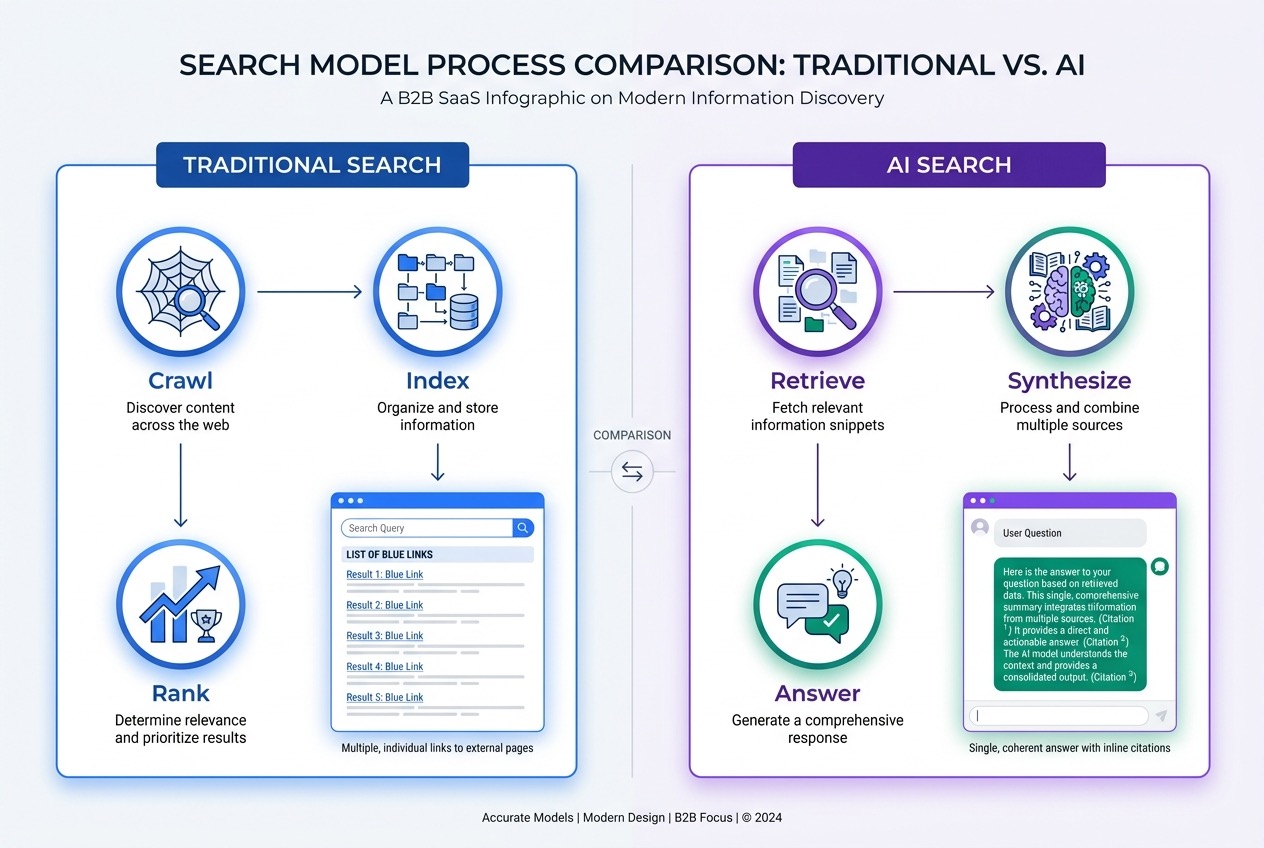
Crawl → Index → Rank → Link. Users receive a list of ranked pages based on relevance and authority signals. Value delivered through clicks. Optimized with keywords, links, and technical SEO. Decades of established best practices.

Mechanics

How AI Search Works

Retrieve → Synthesize → Answer. AI reads multiple sources, resolves contradictions, and generates a direct conversational answer. Citations are footnotes. Value delivered through brand impressions, not clicks. Optimized with entity authority and content structure.

Visibility

Keyword Rank vs Answer Citation

Traditional SEO success = ranking in top 3 positions. AI search success = being cited in the synthesized answer. A brand can excel at one while being invisible in the other. Both require deliberate, separate optimization strategies.

Authority
4.2x

Link Authority vs Entity Authority

Traditional search measures authority through backlinks — who links to your page and how authoritative are those linkers. AI search measures authority through entity graphs — how comprehensively and consistently is your brand represented across trusted knowledge sources: Wikipedia, Wikidata, Google's Knowledge Graph, Crunchbase, LinkedIn, and domain-specific databases. A brand with thousands of backlinks but sparse entity coverage may rank well traditionally but rarely get AI citations.

Business Value

Click Traffic vs Brand Awareness

Traditional search delivers measurable, attributable website traffic. AI search delivers brand impressions that convert to direct searches — harder to attribute but often higher quality. Brands cited in AI answers see 340% more branded searches within 90 days.

Content

Short vs Comprehensive Answers

Traditional SEO often rewards long, comprehensive content that covers a topic from every angle. AI search rewards content where the specific answer to a specific question can be cleanly extracted in 1-3 sentences. Both types of content have a place in a dual-channel strategy.

Users

Who Uses Each

Traditional Google dominates navigational and transactional searches. AI search dominates complex research, multi-part questions, and conversational exploration. Younger users skew toward AI search; established intent queries skew toward Google. Geographic and demographic variation is significant.

Speed

Speed to Result vs Accuracy

Traditional search is fast — milliseconds to results, clicks to answer. AI search trades some speed for a synthesized answer that attempts to be more accurate and comprehensive than any single source. Users accept the tradeoff for complex queries.

Diagram showing traditional search crawl-index-rank model alongside AI search retrieve-synthesize-answer model

The Engine Behind Each Search Model

Traditional search engines spend enormous compute crawling billions of web pages, building inverted indexes, and calculating page rank scores using link graphs. The result is an extraordinarily scalable system that can rank pages for hundreds of billions of unique queries.

AI search engines instead use large language model inference — reading relevant documents and generating a synthesized response on the fly. This is computationally intensive per query but allows for nuanced understanding of complex, conversational, and multi-part questions that traditional keyword matching struggles with.

The convergence point is Google AI Overviews — which uses traditional Google infrastructure to retrieve relevant documents, then applies AI synthesis to generate a direct answer, combining both paradigms into a single product.

65%
Info Queries with AI
8.5B
Daily Google Searches
300%
AI Search Growth

Traditional Google vs AI-Powered Search — Side by Side

The user experience tells the story. Traditional Google returns links. AI search returns answers. Both are happening simultaneously in the same market.

AI Search vs Traditional Search shown across laptop, tablet and phone

Why Google Is Becoming Both Simultaneously

The most significant development in search is not the rise of ChatGPT or Perplexity — it is Google's own decision to transform itself into a hybrid traditional-AI search engine. AI Overviews sit atop traditional blue links on the same page, delivering an AI-synthesized answer while still offering organic results below.

This convergence means that a single Google search can simultaneously generate an AI citation impression (visible in the AI Overview) and an organic click (from a blue link below). Businesses that optimize for both get the brand impression from the AI citation and the traffic from the organic result for the same query.

The businesses that will define the next era of search dominance are those that treat traditional SEO and GEO/AEO as two pillars of a unified strategy, not competing priorities. The window to establish early advantage in AI citation is narrowing as more competitors wake up to the opportunity.

47%
Queries With AI Overlay
82%
Still Show Blue Links
2026
The Pivot Year
Visual showing Google's evolution from pure link directory to hybrid AI-plus-links search engine, with both channels on the same page
The Strategy Gap

Three Ways Businesses Are Caught Between Old and New Search

Most businesses have built their digital strategy entirely for traditional search — and are now invisible in AI search while their competitors establish citation authority.

01

Strategy Built Entirely for Traditional Search

Years of investment in keyword research, link building, and content volume have created strong traditional search visibility — but zero presence in AI answers. When prospects research your industry in ChatGPT or Perplexity, a competitor is cited and you're absent. The strategy that got you here won't get you to the next era.

02

No Content Optimized for AI Extraction

Your content is thorough and well-written — but formatted for human readers and keyword algorithms, not for AI extraction. AI systems need clear, direct, factual answer statements they can pull as citations. Repurposing existing content for AI extractability is often faster than creating new content from scratch.

03

Missing From AI Answers While Competitors Are Cited

The most painful scenario: you search your target questions in Perplexity or ChatGPT and see competitor brands repeatedly cited as authoritative sources. Every AI citation your competitor receives is brand awareness you're not getting. This competitive disadvantage compounds month over month as their AI citation authority builds.

The Dual Strategy

6 Steps to Optimize for Both Search Channels Simultaneously

You don't have to choose between traditional SEO and AI citation optimization — they reinforce each other when built on the right foundation.

01

Audit Current Visibility in Both Channels

Benchmark your traditional search positions for target keywords and simultaneously test your AI citation presence in ChatGPT, Perplexity, Gemini, and Google AI Overviews. Identify gaps — where you rank traditionally but have no AI citation presence — as first priority.

02

Build Entity Authority Foundation

Ensure your brand is accurately and completely represented in Wikipedia, Wikidata, Google Knowledge Graph, LinkedIn Company, Crunchbase, and at least 5 industry-specific databases. Entity completeness is the foundational signal for AI citation systems — without it, no amount of content optimization will get you cited.

03

Restructure Content for Dual Optimization

Add AI-extractable answer paragraphs to existing long-form content — short, direct statements that directly answer target questions. These don't replace depth content (which traditional search rewards) but add the extractable layer that AI systems need to cite your brand.

04

Earn Third-Party Citations

Traditional link building earns links for traditional search. For AI search, you need mentions — your brand name cited in context on authoritative external platforms: industry publications, news coverage, podcast transcripts, research papers, and partner websites. Both types of external signals reinforce each other.

05

Implement Comprehensive Schema Markup

Structured data markup (Article, FAQPage, WebPage, Organization, Product) helps both traditional search (rich results) and AI search (structured extraction). A single schema implementation investment pays dividends across both channels simultaneously.

06

Measure Both Channels in Every Report

Include AI citation frequency and branded search volume alongside traditional organic metrics in every performance report. Showing stakeholders the complete picture — traditional traffic plus AI-driven brand equity — builds the business case for ongoing investment in dual-channel search optimization.

"
We had strong Google rankings but zero presence in ChatGPT or Perplexity. SEO My Clicks built us a dual-channel strategy — we retained our traditional rankings while building AI citation presence. Within 6 months, 40% of our inbound leads mentioned finding us in an AI search tool. We couldn't have measured that before.
J
Jordan P.
CMO, Professional Services Firm
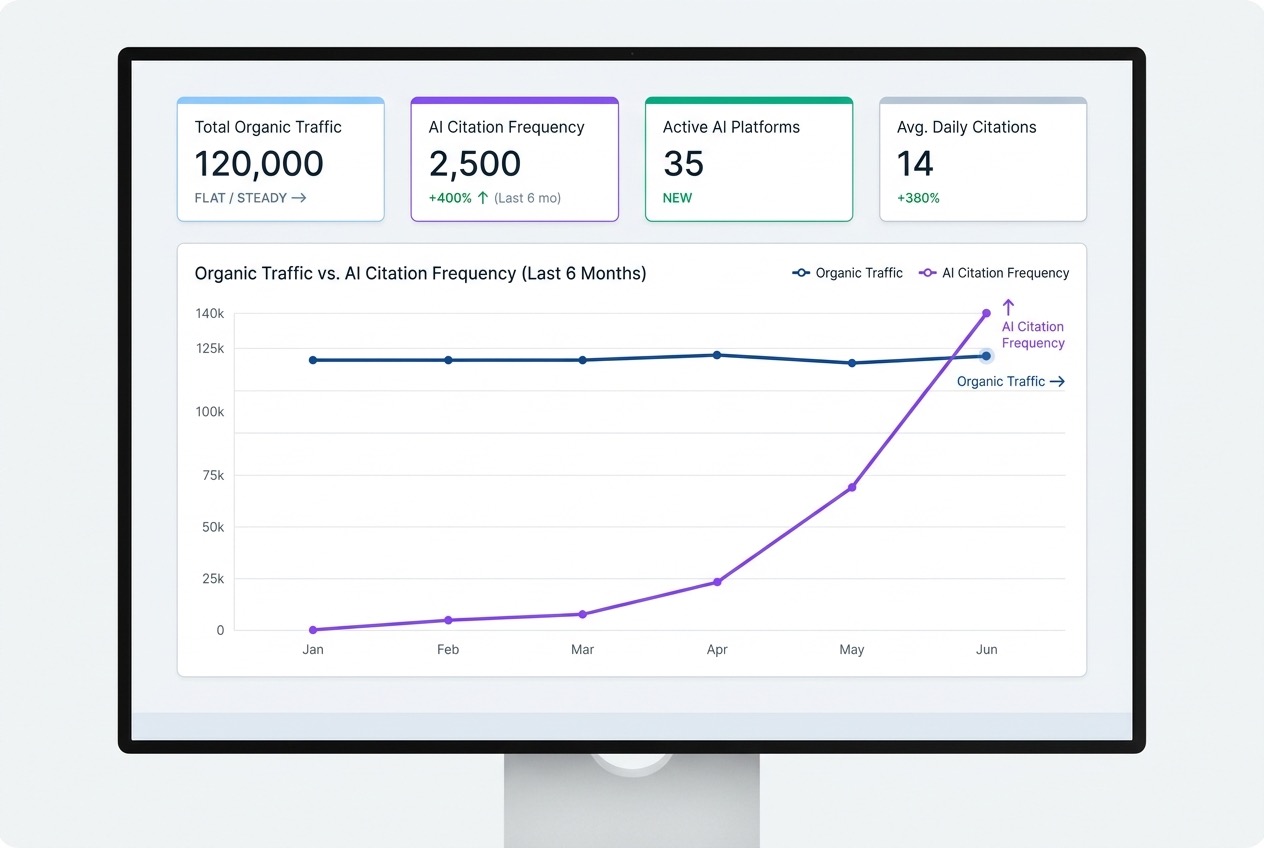
Dashboard showing traditional organic traffic maintained while AI citation frequency grew 400% over 6 months

400% More AI Citations

Traditional rankings maintained while AI visibility grew 4x in 6 months

Frequently Asked Questions

Everything you need to know about navigating both AI and traditional search in 2026.

What is the difference between AI search and traditional search?
Traditional search works by crawling and indexing web pages, then ranking them based on relevance signals like keyword match, backlinks, and page authority. Users receive a list of links and must click through to find their answer. AI search uses large language models to synthesize information from multiple sources and generate a direct, conversational answer. The user does not need to click anywhere — the AI provides the answer inline. Google AI Overviews, ChatGPT Search, Perplexity, and Gemini all use this AI synthesis model to varying degrees.
Will AI search replace Google?
AI search will not replace Google in the near term — it is becoming Google. Google has integrated AI Overviews into its core search product and processes 8.5 billion searches per day with no sign of declining volume. What is changing is the nature of those searches: Google is increasingly functioning as an AI answer engine for informational queries while retaining its link-directory function for transactional and navigational queries. Meanwhile, standalone AI search tools like ChatGPT Search and Perplexity are growing rapidly but have not yet approached Google's scale.
Which is better for business visibility — AI search or traditional search?
For maximum business visibility in 2026, both channels matter and serve different functions. Traditional search drives transactional, high-intent traffic via organic blue links — this remains valuable for commercial and navigational queries. AI search drives brand awareness and authority for informational queries — being cited as an authoritative source in AI answers builds trust and drives branded searches even without direct clicks. Businesses that optimize exclusively for one while ignoring the other leave significant visibility on the table.
How do ranking signals differ between AI and traditional search?
Traditional search ranking signals include keyword relevance, page authority from backlinks, technical SEO factors, user engagement signals, and content freshness. AI search citation signals are fundamentally different: they prioritize content extractability, entity authority (how well-established the brand is across trusted platforms), third-party citation frequency, content recency (AI systems prefer fresher content — 50% of AI-cited content is under 13 weeks old), and answer format quality (direct, concise, factual language that can be cleanly extracted).
How should content strategy change for AI search?
Content strategy for AI search requires a shift from keyword optimization to answer optimization. Instead of writing content around keyword phrases, write content that directly answers specific questions with clear, extractable statements. Use clean heading hierarchies, definition paragraphs, numbered lists, and short factual sentences that AI models can pull as citations. Include author credentials and publication dates, as AI systems weight these for trustworthiness. Create content demonstrating original expertise or data — AI systems prefer to cite sources with unique, verifiable information.
Is traditional SEO dead?
Traditional SEO is not dead, but it is no longer sufficient on its own. Google's organic blue links remain a critical traffic channel, particularly for transactional, commercial, and navigational queries where click-through is necessary for the user to complete their goal. Technical SEO, link building, and keyword optimization remain valuable. However, optimizing only for traditional ranking signals while ignoring AI citation signals means missing an increasingly large portion of search visibility. Modern practitioners must be competent in both traditional SEO and GEO/AEO.
How to measure success across both AI and traditional search?
Measuring success across both search channels requires expanding your measurement framework. Traditional metrics — organic sessions, ranking positions, CTR, domain authority — remain relevant for traditional search. For AI search visibility, measure: AI citation frequency, branded search volume trends, share of voice in AI answers, and direct traffic growth. Together, these metrics give a complete picture of search visibility that accounts for both click-generating and awareness-generating search outcomes.
What industries benefit most from AI search optimization?
Industries with high informational query volume benefit most from AI search optimization — healthcare, legal, financial services, technology, education, and B2B professional services all fit this profile. For these industries, appearing as a cited source in AI answers provides massive brand exposure to high-intent audiences who are researching before making purchasing decisions. Consumer goods and e-commerce also benefit, particularly for research-phase queries where users are deciding what to buy before choosing where to buy it.
Win Both Channels

Optimize for Traditional and AI Search Simultaneously

Most of your competitors are optimizing for one channel or the other. SEO My Clicks builds dual-channel strategies that dominate both — traditional rankings and AI citation authority together.

What our clients say

MR
Marcus R.
marcus@veliomedical.com
Re: 3 months in — wanted to share results
Before SEO My Clicks we had spent £14k on Google Ads with nothing to show for it. They built our organic and AI search presence and we now get consistent qualified leads every week without any ad spend. The dental implant distributor space is competitive and we now show up in Perplexity results consistently.
Mon, 7 Apr · 9:14 AM
JK
jamie_k
#wins · SaaS Founders
Genuinely didn't believe organic + GEO could generate pipeline faster than ads. SEO My Clicks proved me wrong. We went from zero AI search visibility to being cited in ChatGPT answers for our category in under 10 weeks. First inbound from an AI referral last Tuesday
Today at 2:17 PM
NP
Niall P.
@niallp_founder
SDR as a service was exactly what we needed. We couldn't afford a full-time hire but needed someone doing outreach. Within 30 days we had 6 qualified meetings booked with the exact type of client we wanted. No salary, no ramp time.
Tuesday, 10:08 AM
AT
Alisha T.
alisha.t@constructagroup.co.uk
Feedback — 6 months working together
We're a construction materials supplier and had no digital presence at all. SEO My Clicks built our AEO and GEO from scratch. We now appear when procurement managers ask AI tools for suppliers in our category. Three new B2B accounts sourced from AI search in the last quarter alone.
2 Apr 2026, 3:51 PM
rx
roxanne_gtm
#growth-wins · B2B Operators
Just launched 4 months ago and already have 11 paying clients. SEO My Clicks built the outbound engine and GEO presence simultaneously. Would have taken us 18 months to figure this out ourselves.
Yesterday at 6:44 PM
OW
Oliver W.
oliver@physioforward.ie
You won't believe this — ChatGPT recommended us
A new patient told me they found our physiotherapy clinic by asking ChatGPT for recommendations in our area. I had no idea that was even possible. SEO My Clicks had been building our AEO presence for 3 months. It's working.
Fri, 4 Apr · 8:22 AM
DM
dev_marcus
#case-studies · Founders Collective
The team at SEO My Clicks understood our IoT hardware business immediately. No time wasted explaining the industry. GEO optimisation started in week one and by week 9 we were appearing in Gemini answers for procurement-related queries. Genuinely impressive.
Today at 11:03 AM
LF
Lena F.
l.fischer@datasprint.de
Pipeline update — thought you'd want to know
We stopped running paid ads in January and were terrified. SEO My Clicks had been building our organic and AI search presence for 5 months at that point. February was our best lead generation month ever. Zero ad spend. The compounding effect they described is very real.
5 Apr 2026, 10:17 AM
PR
Priya R.
priya@renewapack.com
6 months — here's what changed
We're a packaging manufacturer. Nobody thinks about GEO or AEO in our industry yet. That's exactly why it worked so fast. SEO My Clicks got us cited in AI answers for sustainable packaging suppliers before any of our competitors even knew what GEO was. Three new wholesale accounts this quarter.
Tue, 1 Apr · 2:45 PM
BN
Ben N.
ben@nortonsolicitors.co.uk
Re: How it's going
As a law firm we were completely dependent on referrals. SEO My Clicks changed that. We now have people finding us through Google and through Perplexity searches. The SDR outreach they run on our behalf has added a completely new channel we never had before. Pipeline is finally predictable.
Wed, 2 Apr · 11:33 AM
MR
Marcus R.
marcus@veliomedical.com
Re: 3 months in — wanted to share results
Before SEO My Clicks we had spent £14k on Google Ads with nothing to show for it. They built our organic and AI search presence and we now get consistent qualified leads every week without any ad spend.
Mon, 7 Apr · 9:14 AM
JK
jamie_k
#wins · SaaS Founders
Genuinely didn't believe organic + GEO could generate pipeline faster than ads. SEO My Clicks proved me wrong. First inbound from an AI referral last Tuesday
Today at 2:17 PM
NP
Niall P.
@niallp_founder
SDR as a service was exactly what we needed. Within 30 days we had 6 qualified meetings booked with the exact type of client we wanted. No salary, no ramp time.
Tuesday, 10:08 AM
AT
Alisha T.
alisha.t@constructagroup.co.uk
Feedback — 6 months working together
Three new B2B accounts sourced from AI search in the last quarter alone. SEO My Clicks built our AEO and GEO from scratch and we now appear when procurement managers ask AI tools for suppliers in our category.
2 Apr 2026, 3:51 PM