Everything you need to build a predictable B2B pipeline in 2026 — from ICP definition and inbound content to outbound sequences, intent signals, and conversion. Built for companies serious about 0 to 200+ qualified leads per month.
B2B lead generation has fundamentally changed. The old model — build a list, blast an email, wait for replies — produced declining returns because everyone was doing it. In 2026, the companies winning the pipeline game are those that understand one core truth: your buyer has already done most of their research before you ever talk to them.
According to research from Gartner and Forrester, 68% of B2B buyers now complete 70% of their evaluation before engaging a vendor. They're reading your content, comparing you on review sites, asking AI tools like ChatGPT and Perplexity who the best providers are, and forming opinions about your brand — all before a single form is filled out or a call is booked.
This means B2B lead generation in 2026 requires a two-track strategy. Track one is inbound: ensuring that when your ICP (Ideal Customer Profile) is actively researching, they find you, trust you, and choose to engage. This means SEO for traditional search, GEO (Generative Engine Optimization) for AI search answers, AEO (Answer Engine Optimization) for voice and featured snippets, and high-quality content that actually answers the questions buyers have at each stage of their journey.
Track two is outbound: proactively identifying and reaching out to companies that fit your ICP before they've started research — intercepting them at the top of the funnel. When done with precision (verified contact data, hyper-relevant messaging, multi-channel sequences), outbound generates an ROI of $40 for every $1 invested in email outreach alone.
The companies that treat these two tracks as separate functions lose. The ones that integrate them — using content to warm up outbound prospects, using outbound to accelerate inbound pipeline — see 3x pipeline growth versus single-channel approaches. That integration is what this playbook is about: not just tactics, but the operating system that makes B2B lead generation compound over time.
Whether you're building a lead pipeline from zero or trying to scale from 20 to 200 qualified leads per month, the framework in this guide covers every stage: defining your ICP with the precision that actually moves conversion rates, building multi-channel outreach sequences, launching content that ranks in both traditional and AI search, qualifying leads so your sales team focuses on the right conversations, and retargeting the ones that weren't ready yet but will be.
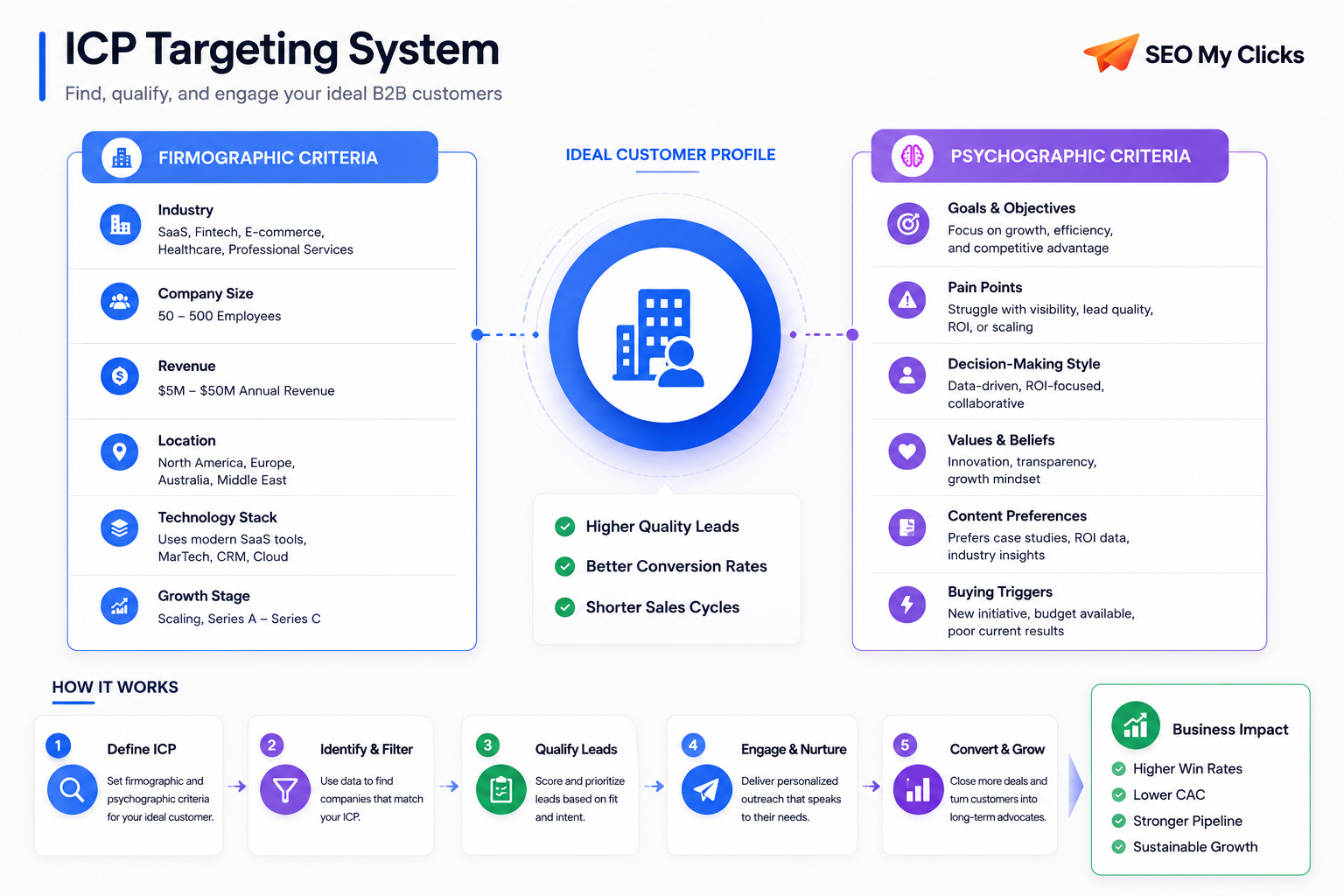
The foundation of every lead gen campaign. Define firmographic fit (company size, industry, revenue), psychographic fit (buyer motivation, pain triggers), and behavioral signals. A precise ICP turns average outreach into qualified pipeline.
SEO, GEO, and AEO working in concert. Rank for buyer-intent keywords in Google, get cited in ChatGPT and Perplexity answers, and convert that traffic with offers that capture leads at every funnel stage.
SDR and BDR programs built on verified data, precise ICP lists, and multi-touch sequences across email and LinkedIn. Outbound that actually books meetings — not blasts that get ignored.
LinkedIn organic for authority building and direct connection requests for pipeline. The right combination of thought leadership content and targeted outreach to decision-makers at ICP companies.
Catch B2B buyers at the exact moment they're actively researching your category. Intent data from Bombora, G2, and behavioral signals identifies companies in-market right now — before they contact you or your competitors. Intent-flagged outreach gets 3-5x higher response rates than cold lists.
Higher response rates with intent data
Gated assets and lead magnets that exchange genuine value for contact information. Playbooks, calculators, templates, and frameworks that attract your ICP and capture them in your pipeline.
Turning leads into qualified meetings and meetings into pipeline. Qualification frameworks, CRM routing, nurture sequences, and SDR scripts that move prospects from cold contact to closed conversation.
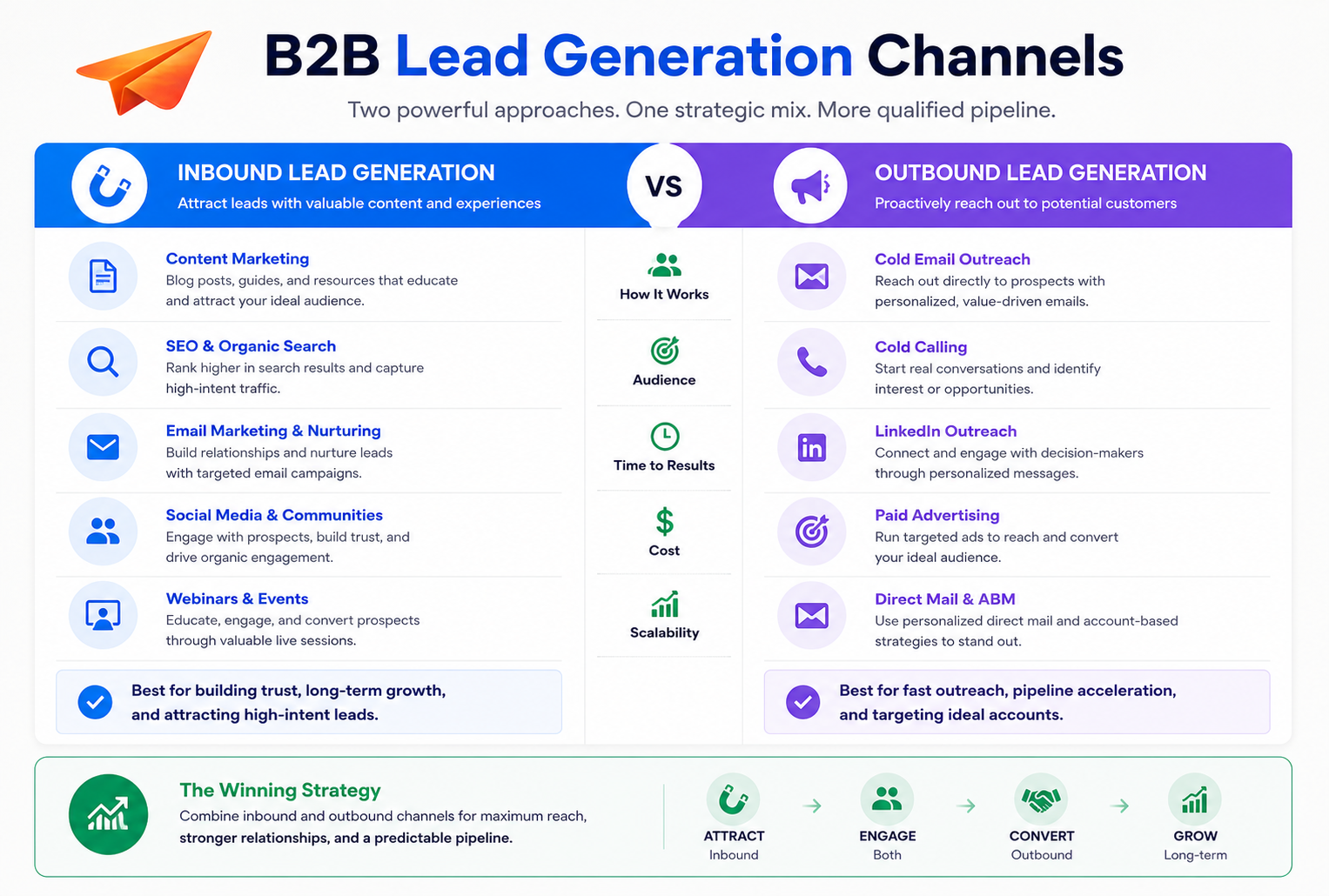
Inbound and outbound aren't competing strategies — they're complementary engines that solve different timing problems. Inbound captures buyers who are already looking; outbound reaches buyers before they start looking.
Inbound generates compounding leads. A piece of content ranking for a buyer-intent keyword works while you sleep, attracting prospects who've already self-qualified by searching for your category. GEO and AEO extend this to AI-generated answers, positioning your brand before a buyer even chooses a search engine.
Outbound generates immediate pipeline. A targeted cold email sequence to verified contacts at ICP-fit companies can produce qualified meetings within two to three weeks of launch. The catch is precision — spray-and-pray outbound produces 0.2% reply rates, while targeted sequences to intent-flagged ICP companies produce 8-15%.
The integration of both is where the compounding happens. Use content to warm up outbound prospects before your SDR reaches out. Use retargeting to stay visible to inbound visitors who didn't convert yet. Use CRM data from outbound conversations to refine what content you create. The flywheel accelerates itself.
CRM pipeline management and mobile outreach sequencing — the operational core of a working lead gen system.
Track every lead from first touch to closed deal. Visualize pipeline stages, see conversion rates at each step, and identify where qualified leads are getting stuck. A clean CRM is the foundation of a scalable lead gen program.
The most common mistake in B2B lead generation is treating it as a volume game. More emails. More ads. More LinkedIn connections. But volume without precision produces noise, not pipeline. The companies generating the most qualified leads per dollar spent are the ones with the most precisely defined ICPs.
A true ICP definition goes beyond "companies with 50+ employees in SaaS." It specifies the exact firmographic profile (revenue range, headcount by department, tech stack, growth stage), the psychographic profile (what the buyer cares about, what keeps them up at night, what outcome they're optimizing for), and the behavioral triggers that indicate a buying window has opened (new funding, recent hire, competitor switch, product expansion).
When you combine that precision with intent data and multi-channel outreach, you're not cold anymore. You're reaching the right person, at the right company, at the right time — with a message that speaks directly to their current reality. That's what turns outreach from a numbers game into a precision instrument.
These are the three lead generation problems we see most in B2B companies that come to us for help.
Generic emails to massive lists getting 0.2% reply rates. When every company gets the same message, none of them feel like you understand their problem. Volume without precision is noise.
Inbound traffic arriving from SEO or ads with no pathway to a lead. No clear CTA, no relevant lead magnet, no qualification step — visitors leave without becoming pipeline.
Sales team taking meetings with wrong-fit companies, wasting time on deals that were never going to close. No MQL-to-SQL process means the pipeline is full of noise and the team is burned out.
Six steps from zero to a predictable, compounding lead generation system.
Firmographic criteria, psychographic profile, behavioral triggers, and exclusion criteria. The sharper the ICP, the higher every downstream conversion rate.
Source contacts from Apollo, ZoomInfo, LinkedIn Sales Navigator, and intent data platforms. Verify emails before sending to protect deliverability.
5-8 touch cadences across email and LinkedIn. Pain-led messaging that speaks to the prospect's reality, not your product features.
SEO-optimized content targeting buyer-intent keywords, structured for GEO and AEO so you appear in both traditional and AI-generated search results.
Apply BANT qualification, score leads by ICP fit and engagement, and route SQLs to sales with full context so every meeting starts informed.
Retarget non-converting visitors and unresponsive outbound prospects. Nurture sequences keep you top of mind until the buying window opens.
Within 60 days of starting with SEO My Clicks we had more qualified pipeline than in the previous 6 months combined. The combination of inbound content and targeted outbound was exactly what we were missing — and the ICP work they did upfront made everything downstream convert better.
We work with B2B companies to build predictable, compounding lead pipelines using inbound, outbound, and AI search — without wasted budget or spray-and-pray tactics.
What our clients say