ChatGPT now has over 1 billion users and a real-time search engine. Understanding exactly how it picks its citations isn't optional — it's your next competitive advantage. This is the definitive breakdown.
When ChatGPT generates an answer, it doesn't "rank" sources the way Google does with PageRank. Instead, it evaluates candidate content through a layered process that combines its pre-trained knowledge, real-time web retrieval (via Bing's index when ChatGPT Search is enabled), and a proprietary relevance and trustworthiness scoring layer. The result is a selection — not a ranking — of two to five sources that best support the generated answer.
The distinction matters enormously for optimization. You're not trying to rank #1 for a keyword. You're trying to be in the selection pool for a given topic and then have your specific content pass four key evaluation gates: content clarity, entity recognition, cross-source corroboration, and recency. Miss any one of these gates and you're out of the citation pool, regardless of your domain authority or traditional SEO performance.
ChatGPT Search, launched in late 2024 and rapidly expanded through 2025, fundamentally changed the AI citation landscape. Before Search, ChatGPT's citations were drawn entirely from its training data — static snapshots of the web up to a knowledge cutoff. With Search enabled (now the default for ChatGPT Plus, Team, and Enterprise users), ChatGPT retrieves and cites live web content in real time. This means the opportunity to be cited is no longer limited to sources that existed at training time. Any page published today can theoretically be cited in a ChatGPT answer tomorrow.
The implications for content strategy are significant. Content that was written for human readers scanning an article — long introductions, narrative context, gradual revelations — often fails at the AI extractability gate. ChatGPT's retrieval system needs to identify the "answer chunk" within your content in milliseconds. If your actual answer is buried in paragraph six after three paragraphs of scene-setting, the retrieval system may identify a competitor's more direct answer instead. This is why structuring content specifically for AI extraction — leading with the answer, using headers as standalone question-answer pairs, making each paragraph independently meaningful — has become a core discipline in the new AI-first SEO.
Sources cited in ChatGPT answers drive a fundamentally different type of traffic than organic blue links. Users who click a ChatGPT citation are not browsing — they've already received an AI-synthesized answer and are clicking through for depth, verification, or to take action. This intent profile explains why citation traffic converts at significantly higher rates: these visitors arrive knowing what they want and having already received social proof that your content is authoritative. The 3–5× citation CTR lift compared to organic blue links understates the full value, because the quality-adjusted value of that traffic is even higher.
Understanding the full ChatGPT citation system — how browsing works, how source selection happens, how content is evaluated — is the prerequisite for building a content strategy that capitalizes on the billion-user AI search revolution. The sections below break down every layer of that system and give you specific, actionable steps to enter — and stay in — ChatGPT's citation pool.
ChatGPT Search uses Bing's index as its retrieval layer. When a query triggers web search, GPT-4o issues a structured Bing query, retrieves top results, fetches page content, and scores each source against the query before synthesizing a cited answer. Your Bing presence is the entry ticket.
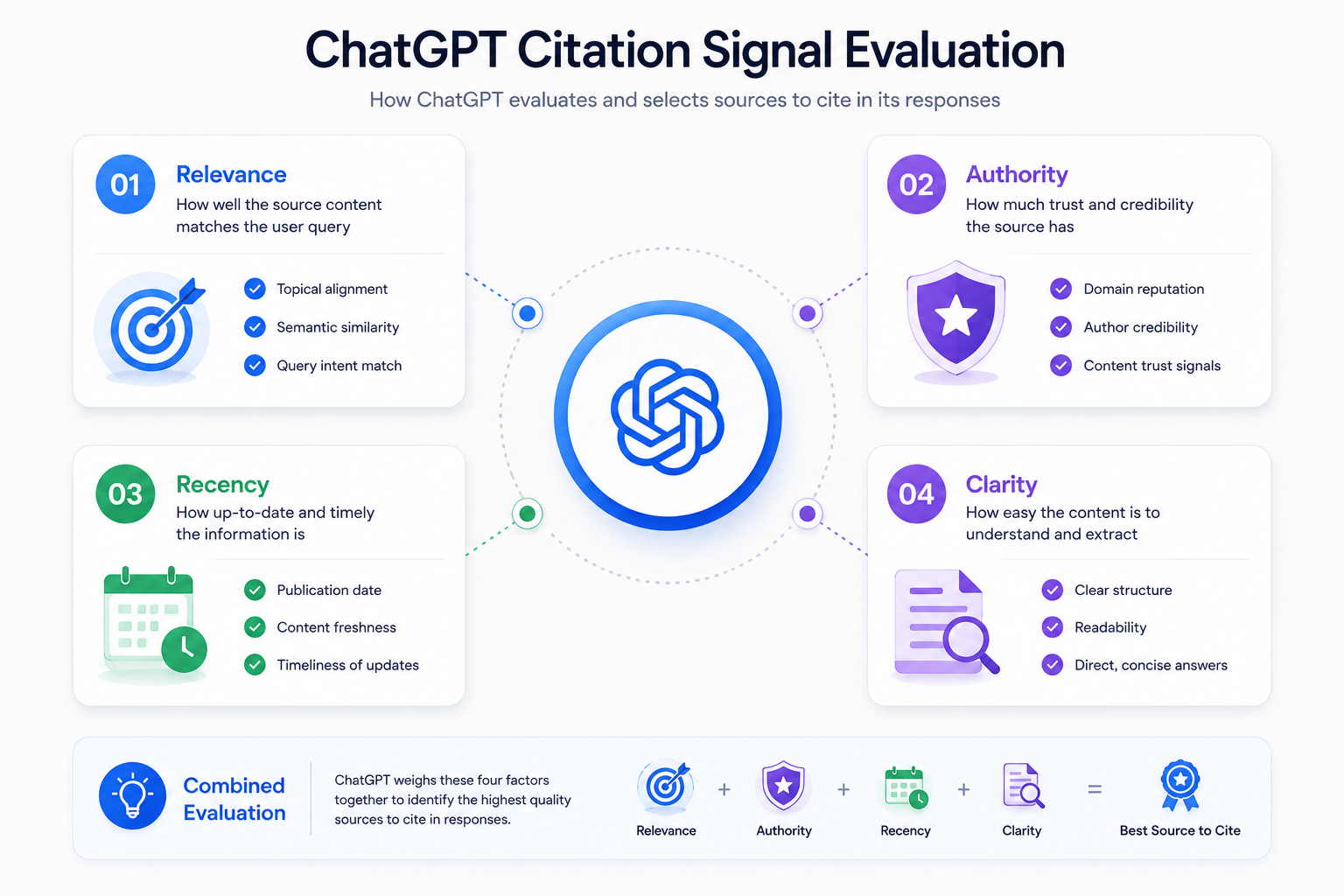
Four core signals drive selection: content clarity, entity recognition, cross-source corroboration, and recency. Missing even one significantly reduces citation probability.
Extractability is the ability of ChatGPT's retrieval system to identify and pull the relevant answer chunk from your page. Pages with clear H2/H3 headers, concise answer-first paragraphs, and factual statements outperform narrative long-form content. Think: can ChatGPT quote three sentences from this page and have them stand alone as a complete answer? If no, rewrite.
78% of ChatGPT-cited content has clear author attribution. Named authors with credentials, bios, and cross-referenced profiles signal trustworthiness to both AI and humans.
ChatGPT's entity graph determines whether your brand, authors, and topics are recognized as established entities. Schema markup, Wikipedia mentions, and consistent NAP data accelerate entity recognition.
For current events and evolving topics, ChatGPT strongly favors recently published or updated content. Pages with visible publish dates and regular update cadences get citation preference over static evergreen pages on time-sensitive subjects.
Numbered lists, definition-style paragraphs, and direct Q&A formatting dramatically increase the probability of your content being extracted and cited verbatim by ChatGPT.
ChatGPT typically cites 2–4 sources per answer. It balances source diversity (rarely citing the same domain twice) and prefers sources that each contribute a distinct piece of the answer. Multi-point articles covering a topic comprehensively earn repeat citations across many related queries.
The four signals ChatGPT applies when evaluating whether to cite a source break down as follows: content clarity measures how directly and unambiguously the page answers the query; entity recognition checks whether the source is associated with recognized people, brands, or concepts in ChatGPT's knowledge base; cross-source corroboration verifies whether other credible sources agree with the information; and recency weights how fresh the content is relative to the query's time-sensitivity.
When ChatGPT cites your page, it displays your domain name as a clickable source link alongside the relevant answer text. On desktop, users see source cards below the response. On mobile, citations appear inline. Both formats drive high-intent clicks to your site from users already primed to engage.
Pages that earn ChatGPT citations typically have clear topic headings, concise answer paragraphs in the first 150 words of each section, and visible author attribution. These are the visual patterns ChatGPT's source display algorithm highlights.
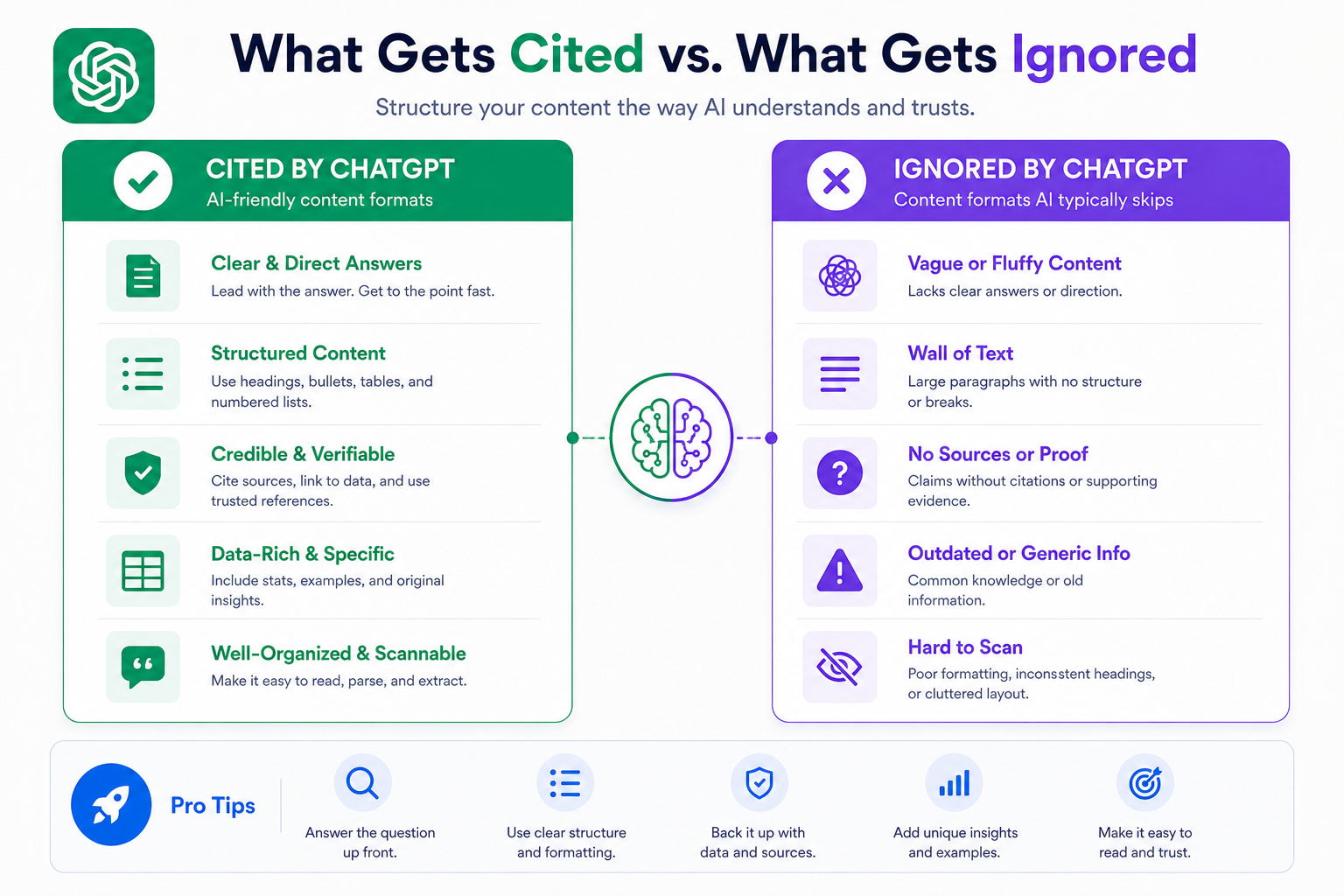
The content that earns ChatGPT citations has one thing in common: extractability. Each key claim stands alone. Answers appear in the opening sentences. Headers are written as questions or direct topic statements. The opposite — walls of narrative text, answers buried after lengthy preambles, content that requires context to understand — is systematically passed over, regardless of how high it ranks on Google.
Content written for broad audiences without specific, extractable factual claims gives ChatGPT nothing to cite. Vague answers, opinion-heavy prose, and content that hedges every statement are systematically excluded from the citation pool. Every page needs a clear, quotable claim.
Anonymous content is a citation red flag. With 78% of ChatGPT-cited content having clear author attribution, publishing without a named author, credentials, and bio puts you at an immediate structural disadvantage. ChatGPT trusts identifiable sources over faceless publishers.
Pages that load slowly, block crawlers in robots.txt, or have thin content (under 300 words of substantive information) are either not indexed by Bing or scored too low to enter the citation candidate pool. Technical accessibility is a prerequisite for AI citation eligibility.
Rewrite introductions to lead with the answer. Use H2/H3 headers as question-or-topic statements. Make every paragraph independently meaningful without requiring surrounding context.
Add a named author with full bio, credentials, and links to their profiles on every article. Add Person schema markup. Build an author archive page with all their published work.
Implement Organization and Person schema. Get your brand mentioned in Wikipedia, authoritative industry directories, and high-DA news sites. Consistent NAP data and Google Business Profile strengthen entity signals.
Cross-source corroboration is a real ChatGPT signal. Earn mentions in industry publications, get quoted in news articles, and build citations from authoritative sources to strengthen your corroboration score.
Add a visible "Last Updated" date to every page. Set up a content refresh schedule for high-priority pages. For time-sensitive topics, publish updates more frequently than competitors.
Set up referral tracking from chat.openai.com in GA4. Use AI visibility tools like Profound or Authoritas. Monitor branded search volume spikes as a proxy for ChatGPT citation activity.
After implementing SEO My Clicks' ChatGPT citation framework, we started appearing in ChatGPT answers for our core product category within six weeks. The traffic quality is unlike anything we've seen from organic — these visitors already know what they want.
ChatGPT Search evaluates sources through four primary signals: content clarity (how directly the page answers the query), entity recognition (whether the page clearly associates with recognized entities like brands, people, or concepts), cross-source corroboration (whether multiple credible sources agree with the information), and recency (how fresh the content is relative to the query type). Pages that deliver concise, extractable answers with clear factual claims and strong author attribution score highest. ChatGPT also uses Bing's index when browsing is enabled, so pages that rank well on Bing have an indirect advantage in the citation pool.
Yes, in theory any publicly accessible, crawlable website can be cited by ChatGPT when browsing is enabled. However, in practice, ChatGPT strongly favors sites with established domain authority, clear authorship, structured content, and content that directly and concisely answers specific questions. Sites blocked by robots.txt, paywalled, slow to load, or lacking clear topical focus are significantly less likely to be cited. New websites can earn citations by producing exceptionally clear, authoritative, and well-structured content on niche topics where the existing web coverage is thin or poor quality.
Page ranking has an indirect but meaningful effect on ChatGPT citations. When ChatGPT Search browses the web, it often uses Bing's search index as a starting point, meaning pages that rank well on Bing are more likely to enter ChatGPT's candidate pool. However, ranking alone doesn't guarantee citation — ChatGPT then evaluates the actual content quality, extractability, and relevance of each candidate page. A lower-ranked page with exceptionally clear, well-structured answers may be cited over a higher-ranked page with vague or hard-to-extract information. The best strategy is to optimize for both traditional SEO and AI extractability simultaneously.
Author attribution is highly important for ChatGPT citations. Research shows that 78% of content cited by ChatGPT has clear author attribution — a named author with credentials, a bio, and ideally links to other published work or social profiles. ChatGPT's training data and real-time browsing both favor content from identifiable, credentialed humans or established organizations over anonymous or ghost-written pages. For maximum citation probability, every piece of content should have a named author with a full bio, relevant credentials listed, and schema markup using the Person or Organization type.
ChatGPT strongly prefers content that is structured for extraction. This means using clear H2 and H3 subheadings that mirror likely search queries, writing answers in the first 1-2 sentences of each section (the inverted pyramid style), using bullet points and numbered lists for multi-part answers, including explicit definitions and factual statements rather than vague prose, and avoiding excessive hedging language. Content that buries the answer under long introductions or relies on visual elements to convey key facts performs poorly. Think of writing for a reader who only sees one paragraph — make every paragraph independently meaningful.
ChatGPT's knowledge is updated in two ways. The base model is periodically retrained with new web data, typically in large batches, meaning there can be a lag of months before new content influences the model's internal knowledge. However, when ChatGPT Search (browsing) is enabled, it fetches live web content in real time, meaning newly published pages can theoretically be cited within days or hours of publication if they rank in Bing's index. For time-sensitive or rapidly evolving topics, the real-time browsing layer is the primary citation mechanism, making fresh, frequently updated content significantly more valuable.
Word count matters less than content structure and answer density. ChatGPT tends to cite pages that answer specific questions clearly and concisely — a 600-word article with a direct, extractable answer will often beat a 3,000-word article that buries the answer. That said, comprehensive long-form content does better for complex multi-part topics where depth is genuinely needed. The key metric is not total word count but the ratio of useful, extractable information to total content length. Pages with excessive preamble, repetitive content, or filler text see reduced citation rates regardless of their total length.
Tracking ChatGPT citations requires a combination of methods. First, set up brand monitoring alerts using Google Alerts or Mention to catch when your URL appears in shared ChatGPT conversations. Second, manually query ChatGPT with questions your content targets and observe whether your site appears in citations. Third, monitor referral traffic in Google Analytics for traffic from chat.openai.com, which indicates users are clicking through from ChatGPT. Fourth, use third-party AI visibility tools like Profound, Authoritas, or BrandMentions AI which now offer specific ChatGPT citation tracking. Finally, monitor changes in branded search volume as a proxy for ChatGPT citation activity.
SEO My Clicks helps brands appear in ChatGPT, Perplexity, Google AI Overviews, and Gemini answers. Our AI citation audit identifies exactly what's holding your content back and builds the roadmap to fix it.
What our clients say