What We Do
Who We Work With
Product Companies
Medical Device Manufacturers Dental Implant Suppliers Surgical Equipment Companies Supplement & Nutraceutical Brands Pharmaceutical Wholesalers Diagnostic Equipment Makers Industrial Machinery Manufacturers Safety Equipment Suppliers Packaging Manufacturers Chemical & Materials Suppliers Construction Materials Companies HVAC Equipment Suppliers IoT & Hardware Manufacturers Networking Equipment Suppliers Robotics & Automation Companies Security Hardware Manufacturers AgriTech Product Companies Renewable Energy Equipment Fashion & Apparel Wholesale Food & Beverage B2B Distribution Cosmetics & Beauty Wholesale Office Equipment & Supplies
Service Businesses
IT & Managed Service Providers Cybersecurity Firms Software Development Studios Cloud Solution Providers Data Analytics Consultancies AI Implementation Firms Management Consultancies HR & Recruitment Agencies Executive Search Firms Business Coaches & Advisors Training & Development Companies PR & Communications Firms Law Firms & Solicitors Accountancy Practices Financial Advisors & Planners Mortgage & Insurance Brokers M&A Advisory Firms Architecture Firms Interior Design Studios Structural Engineering Firms Facilities Management Companies Freight & Logistics Companies
Practitioners & Clinics
Dentists & Dental Clinics Therapists & Counsellors Psychologists & Psychiatrists Cosmetic Surgeons & Clinics Physiotherapists & Chiropractors Nutritionists & Dietitians Fertility Clinics Optometrists & Eye Clinics Hearing Care Specialists Specialist Medical Practices
Growth-Stage & Funded
SaaS & Software Companies Fintech & Financial Services HealthTech & MedTech EdTech & Online Learning PropTech & Real Estate Tech LegalTech Platforms Supply Chain & LogisticsTech Recruitment & HRTech Video Production Companies Branding & Creative Agencies Corporate Catering & Events Corporate Travel Management
How It Works
Resources
Contact Get a Growth Audit →
AI Citation Guide

How Google Gemini
Selects & Cites
Its Answers

Gemini is integrated across 1 billion+ Google surfaces — from Search to Workspace to its standalone assistant. Understanding exactly how it selects and cites content is the key to appearing in its answers.

Gemini Reach
1B+
Google surfaces powered by Gemini
15M+
Gemini Advanced subscribers
2–4
Sources cited per answer
65%
Top 5 pages supply citations
Google-Integrated AI Platform
Google Knowledge Graph Integration
E-E-A-T Signal Optimization
Entity Authority Building
Gemini Workspace Visibility
Structured Content for AI Extraction
How Gemini Works

The Gemini Citation Selection System

Gemini is not a standalone AI engine — it is Google's AI layer deployed across its entire product ecosystem. Understanding its citation logic requires understanding its relationship with Google Search.

Gemini's Infrastructure Advantage

Unlike ChatGPT or Perplexity, which operate independently from a major search engine, Google Gemini is built on top of Google's search infrastructure. When Gemini generates an answer to a query, it retrieves candidate content from Google's index — the same index used by traditional Google Search. This means the first filter for Gemini citation is: is this page indexed and ranked by Google? Pages that Google cannot crawl, has penalised, or ranks very poorly are unlikely to appear as Gemini citation candidates regardless of content quality. This creates a unique dual-requirement for Gemini visibility: you need strong traditional SEO performance to even be considered, and then strong GEO content optimization to be selected from those considered pages.

The Knowledge Graph Connection

Gemini has deep integration with Google's Knowledge Graph — the massive entity database that powers Knowledge Panels, rich results, and featured snippets in traditional Google Search. When Gemini evaluates a brand or concept mentioned in content it is considering for citation, it cross-references the Knowledge Graph to verify entity information. Brands with well-established Knowledge Graph entries — correct business information, verified categories, consistent NAP data across the web, and Wikipedia or Wikidata entries — receive a trust signal boost that makes Gemini more likely to cite them. This is why Google Business Profile verification, structured organization schema, and consistent brand information across authoritative directories matters specifically for Gemini visibility in ways it does not for other AI engines.

The E-E-A-T Evaluation Layer

After retrieving candidate pages from Google's index, Gemini applies its own content quality evaluation. This evaluation is heavily influenced by Google's E-E-A-T framework — Experience, Expertise, Authoritativeness, and Trustworthiness. These are the same signals that Google's human quality raters evaluate in traditional search, and Gemini inherits this evaluation logic. For citation selection, Gemini looks for: demonstrated real-world experience (case studies, first-person accounts), identifiable expert authorship (named authors with verifiable credentials), external recognition of authority (mentions and citations from other authoritative sources), and trust signals (transparent contact information, factual accuracy, clear dating of information). Content from anonymous authors on thin domains with no external recognition is routinely passed over in favour of substantive content with verifiable authority signals, even if the content answers the question adequately.

Where Gemini Differs from Other AI Engines

The most important strategic difference between Gemini and other AI citation systems is the weight it places on existing Google Search performance. In practice, this means that brands with poor Google Search rankings face a double challenge for Gemini — they must improve their SEO performance to even be retrieved as candidates, and simultaneously optimize their content structure for GEO extraction to be selected from those candidates. However, this also means that brands with strong existing SEO who add GEO optimization on top see Gemini results faster than any other AI platform — because the retrieval candidate pool is already strong. Gemini is therefore the highest-return GEO investment for brands that already have solid SEO foundations.

Citation Signals

What Gemini Looks For When Selecting Sources

Primary Signal

Google Search Ranking + E-E-A-T

Gemini retrieves candidates from Google's index, so SEO performance is the entry gate. Pages ranking in positions 1–5 supply 65% of Gemini's cited content. E-E-A-T quality evaluation then determines which retrieved pages are actually cited in the generated answer.

  • Strong traditional Google Search ranking required
  • Experience, Expertise, Authoritativeness, Trustworthiness evaluated
  • Named authors with verifiable credentials prioritised
Entity Signal

Knowledge Graph Recognition

Brands with established Google Knowledge Graph entries receive a trust boost. Gemini cross-references the Knowledge Graph when evaluating brand mentions — verified entities are cited more confidently.

Content Signal

Structured Extractability

Clear question-format H2 headings, direct answer opening paragraphs, bulleted lists, and FAQ sections. Gemini favours pages where the answer can be extracted cleanly without inference.

Freshness

dateModified Signal

13wk
Gemini heavily weights recently updated content — 50% of citations are under 13 weeks old
Schema

Structured Data Priority

FAQPage, Article, HowTo, and Speakable schema are particularly valued. Gemini uses structured data to understand content structure and to identify the most extractable answer sections on a page.

Depth

1,200–3,500 Word Sweet Spot

Gemini prefers comprehensive pages over thin content. The ideal citation-candidate page covers one primary question fully and 3–5 related sub-questions with structured H2 coverage for each.

Publisher Trust
3M+
Businesses use Google Workspace Gemini — a separate citation environment requiring author entity optimization
Multimodal

Image + Video Content Bonus

Gemini's multimodal capabilities mean pages with properly labelled images and video content receive additional citation signals. Alt text, captions, and video schema all contribute to Gemini evaluating a page as higher quality.

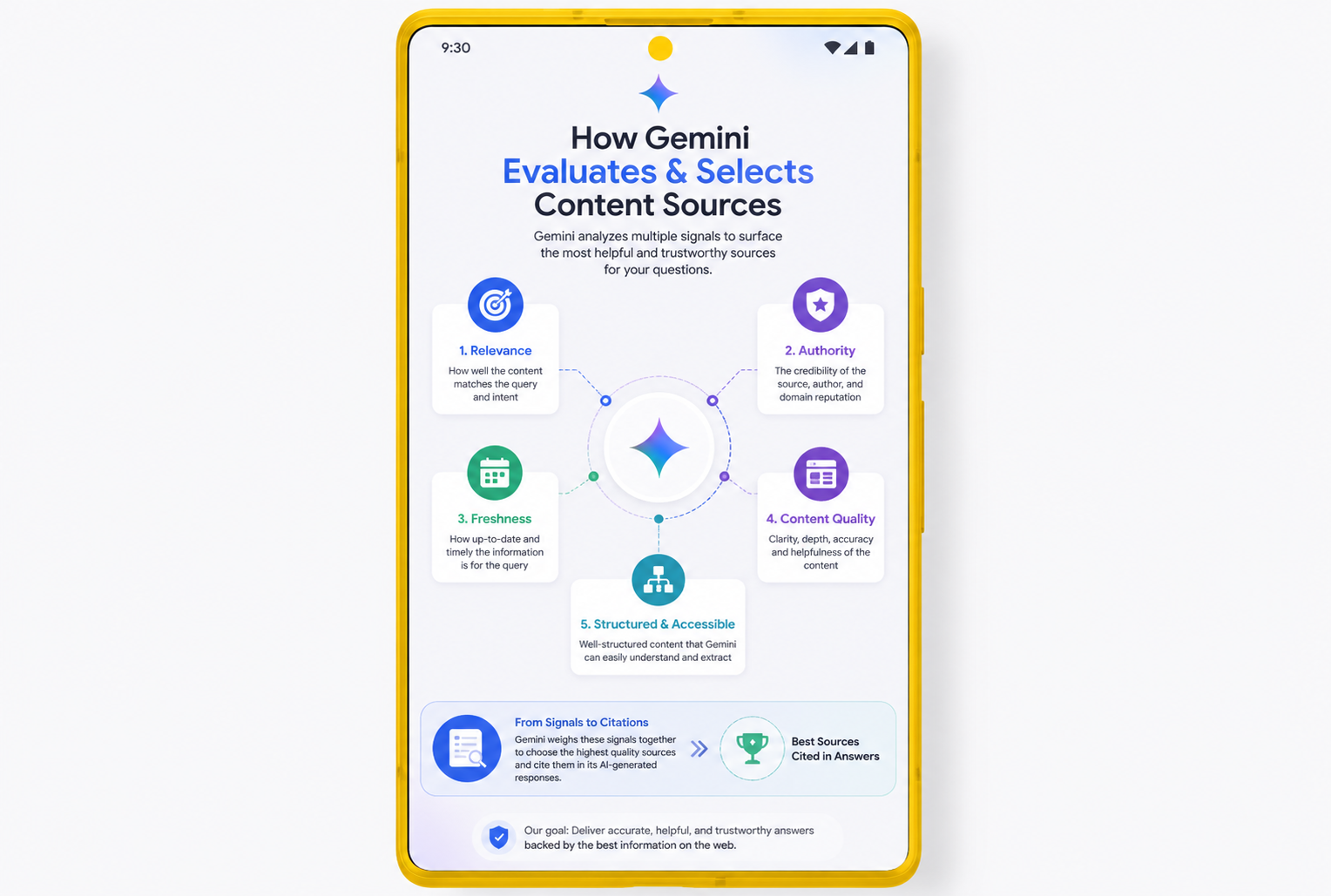
Diagram showing how Google Gemini evaluates and selects content sources for its AI-generated answers
How Selection Works

Gemini's Two-Stage Selection Process

Gemini's citation selection works in two distinct stages. Stage 1 is retrieval — Gemini pulls candidate pages from Google's Search index using the same infrastructure as traditional Google Search. Only indexed, accessible, reasonably well-ranked pages make it into this candidate pool. Stage 2 is selection — Gemini's language model evaluates the retrieved candidates for content quality, extractability, E-E-A-T signals, freshness, and entity recognition to determine which 2–4 sources to cite in its generated answer.

The implication for optimization is critical: you need to solve both stages independently. A perfectly GEO-optimized page on a domain with poor SEO performance may never make it into Gemini's retrieval candidate pool. A page with excellent SEO rankings but poor content structure and no schema may be retrieved but not selected. Only pages that pass both stages consistently appear in Gemini citations.

65%
Citations come from top-5 ranked pages
2–4
Sources cited per Gemini response
47%
Google searches show Gemini AI Overview
See It In Action

Gemini Across Surfaces

Gemini appears in multiple Google products. Optimization for one surface — like Google Search AI Overviews — does not automatically translate to Gemini Advanced or Workspace Gemini.

How Google Gemini Selects and Cites Answers shown across laptop, tablet and phone

Gemini in Google Search

AI Overviews powered by Gemini appear in 47% of Google searches. This is the highest-volume Gemini citation surface — optimizing here requires both strong SEO and GEO content structure.

Gemini Standalone App

The Gemini mobile app and web app generate answers across any topic. It has 15M+ Advanced subscribers and represents a growing direct-query surface separate from Google Search.

Gemini vs Other AI Engines

What Makes Gemini Different from ChatGPT for Citations

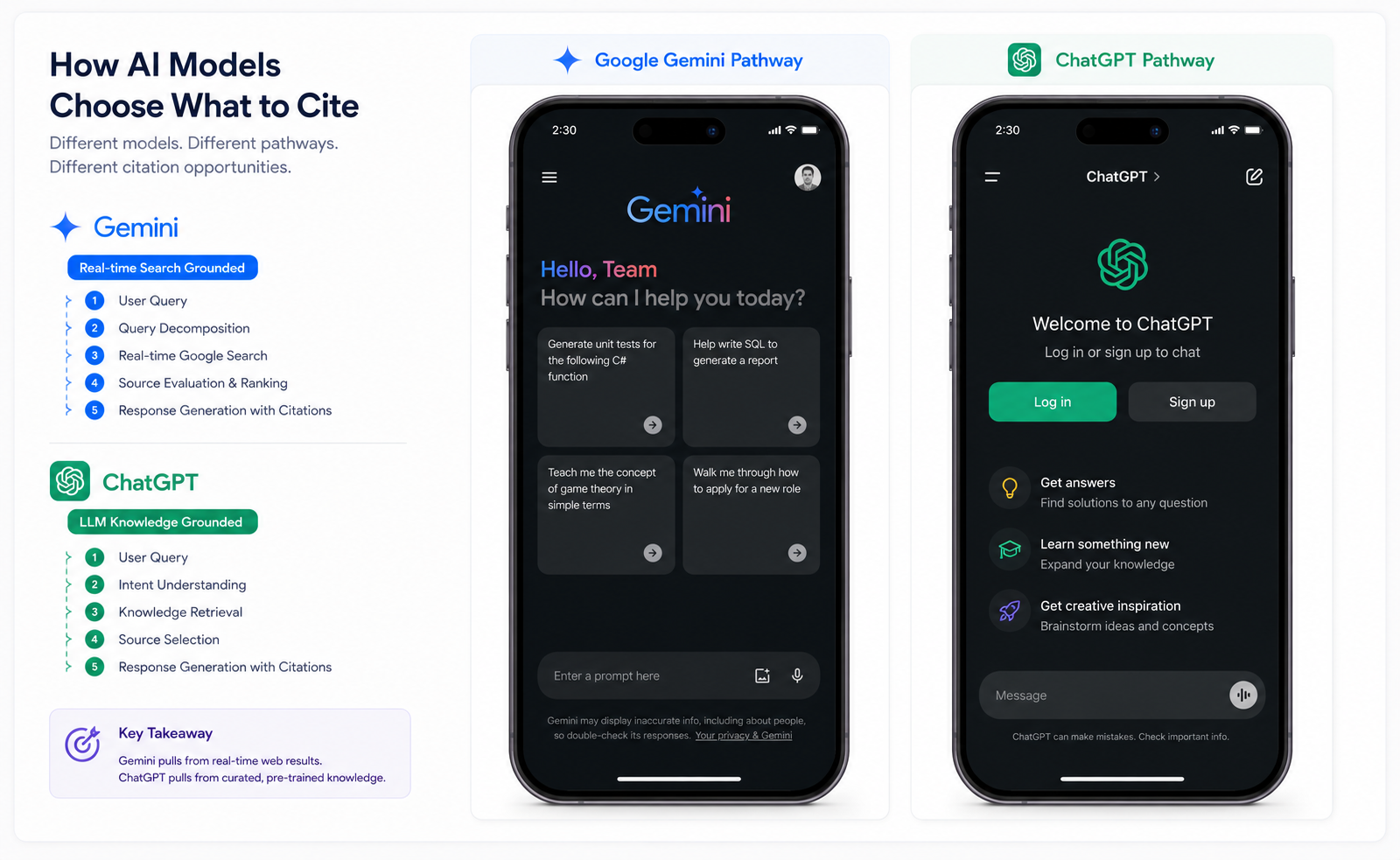
The fundamental difference between optimizing for Gemini and optimizing for ChatGPT is the role of Google Search performance. ChatGPT Search uses Bing's index and applies its own independent crawling and evaluation. Your Google Search rankings are largely irrelevant to ChatGPT citation selection. Gemini, in contrast, retrieves content from Google's index — meaning your Google rankings are the first filter for Gemini candidacy.

This creates different priority orderings for each platform. For Gemini optimization: start with traditional Google SEO to ensure strong indexing and ranking, add E-E-A-T signals (named authors, verified entity information, Google Business Profile), build Knowledge Graph presence, then layer GEO content structure on top. For ChatGPT optimization: focus on Bing indexing, cross-platform brand mentions, content extractability, and ChatGPT-specific crawl allowances. Both require GEO content optimization — but the foundation work differs.

1B+
Google surfaces with Gemini integrated
3M+
Businesses using Workspace Gemini
200%
Gemini query volume growth YoY
Comparison showing different citation selection pathways for Google Gemini versus ChatGPT
Common Mistakes

Why Brands Miss Gemini Citations

01

Blocking Google-Extended in robots.txt

Many websites accidentally block Google-Extended — the crawler Gemini uses — in their robots.txt. If Google-Extended is blocked, Gemini cannot access your content at all. This is the first thing to check when you're invisible in Gemini answers despite strong SEO performance.

02

No E-E-A-T Signals on Key Pages

Anonymous content with no author byline, no credential information, and no external authority signals fails Gemini's quality evaluation layer. Even a well-structured page gets passed over if Gemini cannot verify that the content comes from a credible, experienced author or organisation.

03

Missing Knowledge Graph Entity Entry

Brands not established in Google's Knowledge Graph lose the entity verification trust boost that Gemini applies when evaluating sources. Building a Knowledge Graph presence — via Google Business Profile, Wikidata, consistent NAP data, and structured organization schema — is a Gemini-specific optimization that many GEO programs overlook.

Implementation

6 Steps to Appear in Gemini Answers

01

Verify Google-Extended Access

Check robots.txt allows Google-Extended. Verify your pages are indexed and ranking reasonably well in Google Search — this is the retrieval gate for Gemini candidacy.

02

Build Knowledge Graph Presence

Verify Google Business Profile, add Wikidata entry if eligible, ensure consistent NAP across all directories, implement Organization schema with complete contact and identity information.

03

Add E-E-A-T Signals

Name every author with credentials, create detailed author bio pages with LinkedIn links, add Article schema with author information, earn third-party mentions from authoritative sources in your industry.

04

Structure Content for Extraction

Rewrite key pages with direct-answer openings, question-format H2 headings, FAQ sections at the bottom of every page, numbered lists for multi-step content, and FAQPage + HowTo schema.

05

Implement Freshness Protocol

Add visible "Last Updated" dates to all pages, implement dateModified in Article schema, refresh key pages on a 13-week cycle with updated statistics, new insights, and current publication dates.

06

Monitor & Track Citations

Run weekly Gemini citation audits — query 10–15 category questions in Gemini and record citations. Track branded search volume in Google Search Console as a proxy metric for Gemini citation activity.

Client Success

From Invisible to Cited in Gemini

"

We had good Google rankings but zero Gemini citations. SEO My Clicks identified that our robots.txt was blocking Google-Extended and we had no author attribution on any pages. After fixing both and restructuring our top 15 pages, we started appearing in Gemini answers within 5 weeks. Our Gemini visibility now drives 28% of our branded search volume.

Daniel F.
Head of Growth, Fintech Company
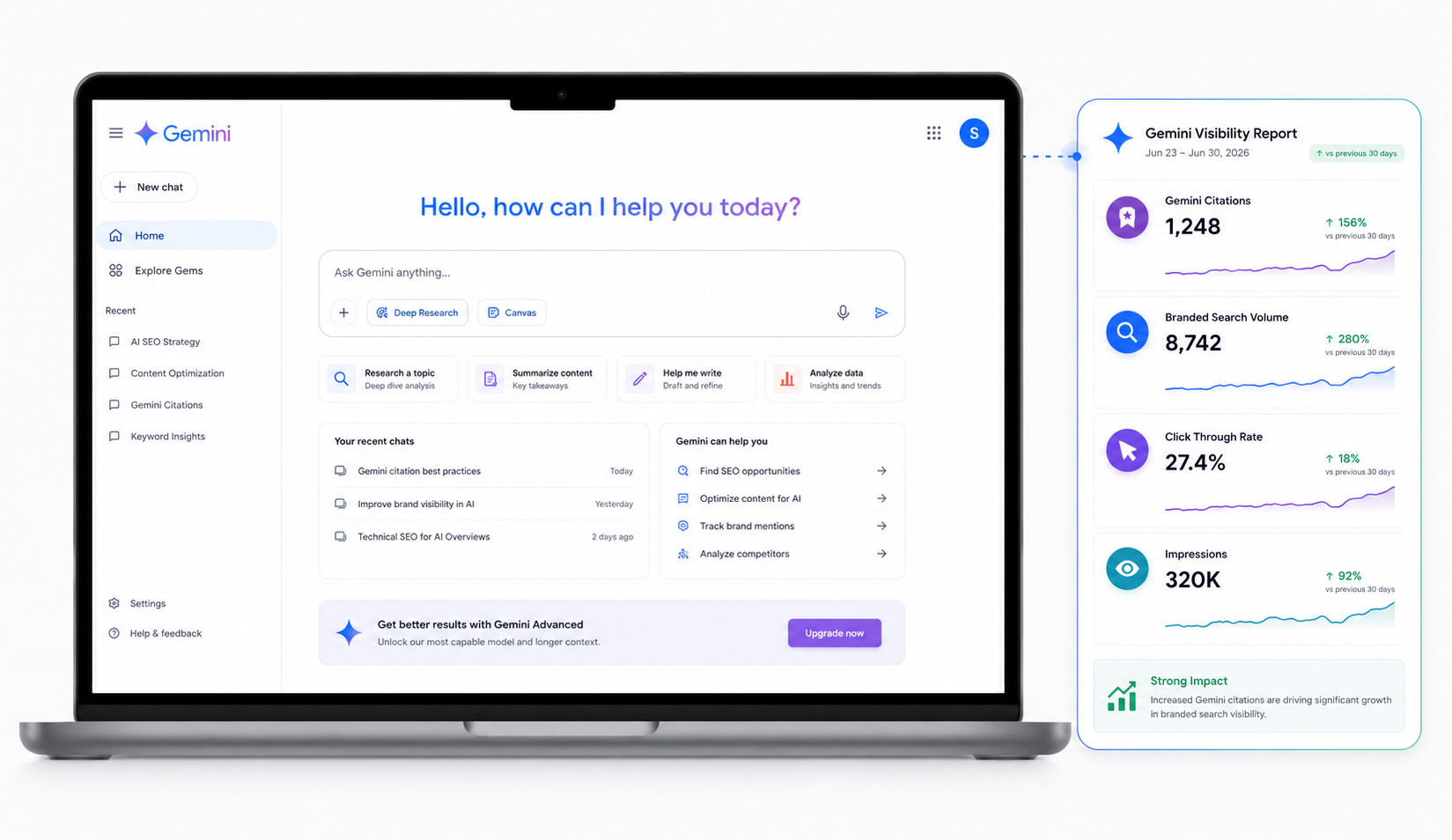
Analytics dashboard showing branded search growth correlated with Gemini citation activity
Gemini Citation Result
+280% Branded Search
In 90 days from first Gemini citation
Common Questions

How Gemini Selects Answers: FAQ

How does Google Gemini choose what to cite?

Gemini prioritises pages that already perform well in Google Search and layers its own extraction quality assessment on top. It evaluates content structure (clear headings and extractable answer sections), entity recognition (brand in Google's Knowledge Graph), author credentials (verifiable expertise), content freshness (dateModified schema and visible publication dates), and factual accuracy. Gemini typically cites 2–4 sources per response. Pages ranking in positions 1–5 on Google provide 65% of Gemini's cited content, though strong structured content from lower-ranked pages can still be cited if it's more extractable than higher-ranked alternatives.

Is Gemini connected to Google Search rankings?

Yes — Gemini's citation selection has significant correlation with Google Search rankings, but it is not a direct mapping. Gemini uses Google Search infrastructure to retrieve candidate pages, meaning indexed and ranked pages have the opportunity to be cited. Gemini then applies its own quality and extractability evaluation. A page ranking position 1 has the highest probability of evaluation, but if the content is poorly structured for extraction — no clear answer sections, buried key information, no schema — a more extractable page at position 4 might be cited instead. Strong SEO is necessary but not sufficient for Gemini citation.

How does Gemini differ from ChatGPT for citations?

Gemini is tightly integrated with Google's search and knowledge infrastructure — it retrieves candidates from Google's index, weights Google rankings significantly, and relies on Google's Knowledge Graph for entity verification. ChatGPT Search uses Bing's index and its own crawling — your Google rankings are irrelevant for ChatGPT citation. For businesses, optimizing for Gemini is more closely tied to traditional Google SEO and Google entity signals (Business Profile, Knowledge Panel). Optimizing for ChatGPT requires a separate signal set. SEO My Clicks implements both simultaneously so brands are cited across all major AI engines without duplicating work.

What content format does Gemini prefer?

Gemini consistently prefers content that combines depth with clear structure. The ideal Gemini-optimized page: opens with a direct answer in the first 1–2 paragraphs, uses question-format H2 headings, includes numbered or bulleted lists, provides attributed statistics with source and date, implements Article, FAQPage, and HowTo schema, has a named author byline with credentials, shows visible publication and update dates, and is 1,200–3,500 words in length. Gemini prefers pages that answer one primary question fully and 3–5 related sub-questions with structured H2 coverage for each — so it can extract multiple useful pieces of information from a single source.

How important is E-E-A-T for Gemini?

E-E-A-T is more critical for Gemini than for any other AI engine because Gemini inherits Google's quality evaluation framework. Experience signals include first-person accounts, case studies, and demonstrated real-world application. Expertise signals include author credentials and professional certifications. Authoritativeness comes from external recognition — mentions and links from other authoritative sources. Trustworthiness includes transparent authorship, factual accuracy, primary source citations, and clear contact information. Building strong E-E-A-T is therefore simultaneously a Google SEO investment and a Gemini optimization investment — the only AI citation signal that serves both systems equally.

How do you track Gemini citations?

Tracking Gemini citations requires a systematic manual audit since Gemini provides no citation dashboard. Run 20–30 targeted queries in Gemini covering your core category questions, branded queries, and competitor-comparison questions. Record which queries result in your brand being cited, what content is referenced, and which URL is cited. Run this audit bi-weekly to track citation frequency. Additionally, monitor branded search volume in Google Search Console — brands cited by Gemini see branded search increases of 200–340% as users search for you directly after encountering your brand in a Gemini answer. Sudden branded search spikes often indicate Gemini citation activity even before manual audits catch it.

Does Google authorship help Gemini citation?

Author attribution is a significant positive signal for Gemini. Google has invested heavily in author entity recognition — the ability to identify an author as a real, credible person with verifiable expertise. Content written by identifiable authors with established online presence (LinkedIn profile, industry publications, speaker bios) is more likely to be cited than anonymous content. To maximize authorship signals: ensure every article has a named author byline, link to a detailed author bio page listing credentials, link the author bio to their LinkedIn profile and authoritative profiles, and implement Article schema with author information. This is especially important in YMYL categories — health, finance, legal — where Gemini applies the highest scrutiny to source credibility.

What content length does Gemini prefer?

Gemini demonstrates a preference for comprehensive content over thin pages — but the key is information density and structural clarity, not length alone. Gemini most commonly cites pages in the 1,200–3,500 word range. Below 800 words, pages are often too thin to be Gemini's authoritative source. Above 4,000 words without clear structural organization, content becomes harder to extract cleanly. The optimal approach: create content as long as needed to fully answer the primary question and its most important sub-questions, with each major sub-topic given its own H2 heading and 200–300 words of coverage. Pages that answer one primary question and 3–5 related sub-questions in this structured format consistently perform best for Gemini citation.

Start Appearing in
Gemini Answers

SEO My Clicks implements the complete Gemini optimization stack — Google Search performance, E-E-A-T signals, Knowledge Graph entry, content structure, and citation monitoring. Get your Gemini visibility audit today.

What our clients say

MR
Marcus R.
marcus@veliomedical.com
Re: 3 months in — wanted to share results
Before SEO My Clicks we had spent £14k on Google Ads with nothing to show for it. They built our organic and AI search presence and we now get consistent qualified leads every week without any ad spend. The dental implant distributor space is competitive and we now show up in Perplexity results consistently.
Mon, 7 Apr · 9:14 AM
JK
jamie_k
#wins · SaaS Founders
Genuinely didn't believe organic + GEO could generate pipeline faster than ads. SEO My Clicks proved me wrong. We went from zero AI search visibility to being cited in ChatGPT answers for our category in under 10 weeks. First inbound from an AI referral last Tuesday
Today at 2:17 PM
NP
Niall P.
@niallp_founder
SDR as a service was exactly what we needed. We couldn't afford a full-time hire but needed someone doing outreach. Within 30 days we had 6 qualified meetings booked with the exact type of client we wanted. No salary, no ramp time.
Tuesday, 10:08 AM
AT
Alisha T.
alisha.t@constructagroup.co.uk
Feedback — 6 months working together
We're a construction materials supplier and had no digital presence at all. SEO My Clicks built our AEO and GEO from scratch. We now appear when procurement managers ask AI tools for suppliers in our category. Three new B2B accounts sourced from AI search in the last quarter alone.
2 Apr 2026, 3:51 PM
rx
roxanne_gtm
#growth-wins · B2B Operators
Just launched 4 months ago and already have 11 paying clients. SEO My Clicks built the outbound engine and GEO presence simultaneously. Would have taken us 18 months to figure this out ourselves.
Yesterday at 6:44 PM
OW
Oliver W.
oliver@physioforward.ie
You won't believe this — ChatGPT recommended us
A new patient told me they found our physiotherapy clinic by asking ChatGPT for recommendations in our area. I had no idea that was even possible. SEO My Clicks had been building our AEO presence for 3 months. It's working.
Fri, 4 Apr · 8:22 AM
DM
dev_marcus
#case-studies · Founders Collective
The team at SEO My Clicks understood our IoT hardware business immediately. No time wasted explaining the industry. GEO optimisation started in week one and by week 9 we were appearing in Gemini answers for procurement-related queries. Genuinely impressive.
Today at 11:03 AM
LF
Lena F.
l.fischer@datasprint.de
Pipeline update — thought you'd want to know
We stopped running paid ads in January and were terrified. SEO My Clicks had been building our organic and AI search presence for 5 months at that point. February was our best lead generation month ever. Zero ad spend. The compounding effect they described is very real.
5 Apr 2026, 10:17 AM
PR
Priya R.
priya@renewapack.com
6 months — here's what changed
We're a packaging manufacturer. Nobody thinks about GEO or AEO in our industry yet. That's exactly why it worked so fast. SEO My Clicks got us cited in AI answers for sustainable packaging suppliers before any of our competitors even knew what GEO was. Three new wholesale accounts this quarter.
Tue, 1 Apr · 2:45 PM
BN
Ben N.
ben@nortonsolicitors.co.uk
Re: How it's going
As a law firm we were completely dependent on referrals. SEO My Clicks changed that. We now have people finding us through Google and through Perplexity searches. The SDR outreach they run on our behalf has added a completely new channel we never had before. Pipeline is finally predictable.
Wed, 2 Apr · 11:33 AM
MR
Marcus R.
marcus@veliomedical.com
Re: 3 months in — wanted to share results
Before SEO My Clicks we had spent £14k on Google Ads with nothing to show for it. They built our organic and AI search presence and we now get consistent qualified leads every week without any ad spend.
Mon, 7 Apr · 9:14 AM
JK
jamie_k
#wins · SaaS Founders
Genuinely didn't believe organic + GEO could generate pipeline faster than ads. SEO My Clicks proved me wrong. First inbound from an AI referral last Tuesday
Today at 2:17 PM
NP
Niall P.
@niallp_founder
SDR as a service was exactly what we needed. Within 30 days we had 6 qualified meetings booked with the exact type of client we wanted. No salary, no ramp time.
Tuesday, 10:08 AM
AT
Alisha T.
alisha.t@constructagroup.co.uk
Feedback — 6 months working together
Three new B2B accounts sourced from AI search in the last quarter alone. SEO My Clicks built our AEO and GEO from scratch and we now appear when procurement managers ask AI tools for suppliers in our category.
2 Apr 2026, 3:51 PM