Google AI Overviews now appear in 47% of searches, reaching 2 billion users monthly. They're the most significant change to Google Search in a decade. Here's exactly how they work — and how to get your content cited in them.
Google AI Overviews are AI-generated summary answers that appear at the very top of Google Search results pages, above organic blue links, for eligible queries. They use Google's Gemini language model to synthesize information from multiple web sources into a single structured answer, with citations to the specific pages that contributed to the synthesis. Since their full US launch in May 2024 — following over a year of testing as Search Generative Experience (SGE) — AI Overviews have rapidly expanded to cover approximately 47% of all Google searches, fundamentally changing how users interact with search results.
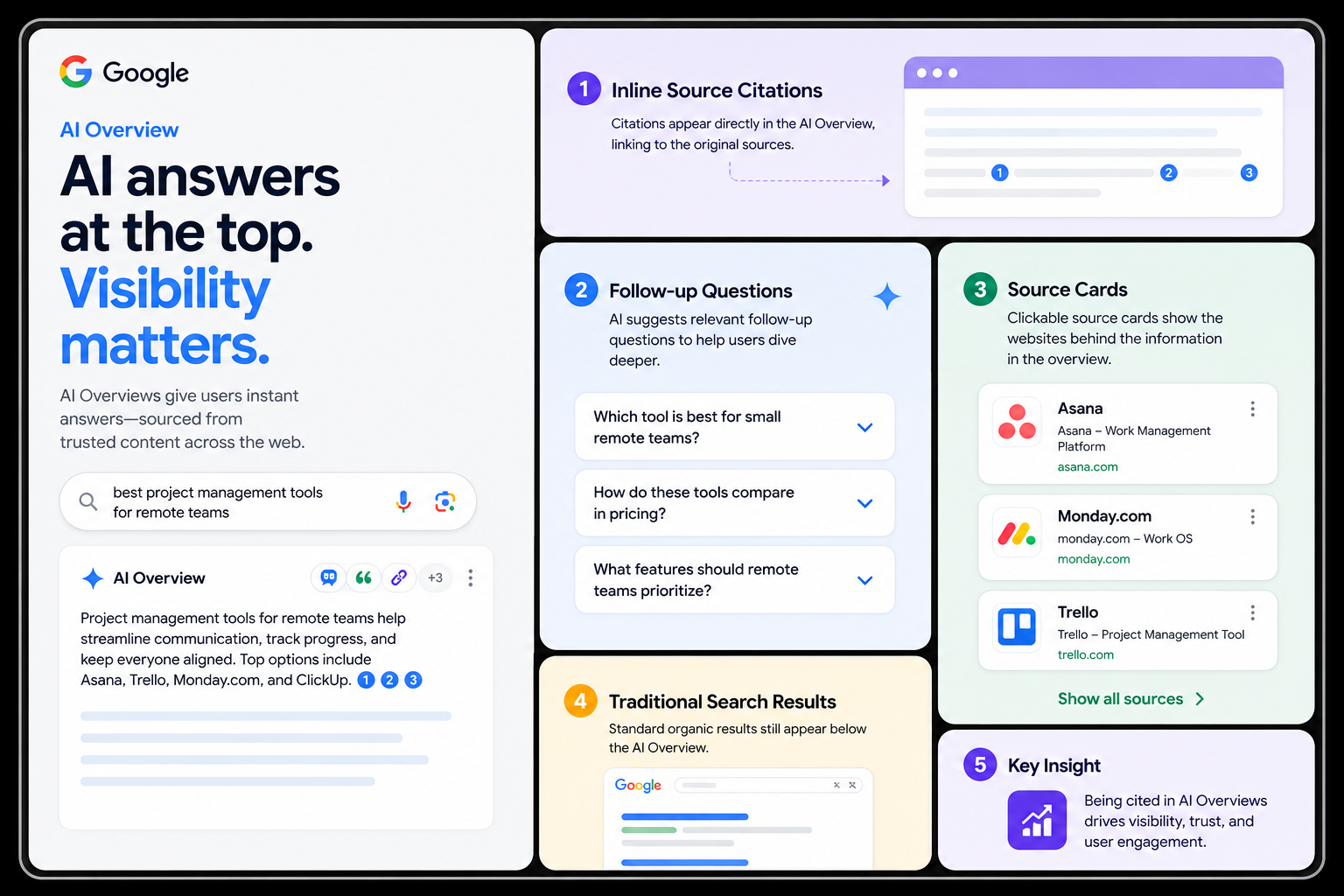
The architecture of an AI Overview consists of several distinct zones. The main synthesis area contains the generated answer, typically 150-300 words organized in paragraphs or bullet points. Below or alongside the synthesis, source cards display the specific web pages Google cited, showing the domain name, page title, and a brief excerpt from the cited content. Users can expand the overview for more detail, collapse it to see organic results, or click individual source cards to visit the cited pages. Follow-up question chips are often displayed below the Overview, creating a conversational search experience that keeps users in the Google ecosystem while still sending citation traffic to cited sources.
Understanding what triggers an AI Overview is the first step in optimizing for one. Google applies AI Overviews most heavily to informational queries — questions seeking explanations, definitions, comparisons, and how-to guidance. Queries with clear question structure (how, what, why, which, when) trigger AI Overviews at high rates. Complex multi-part questions that previously would have generated featured snippets are particularly strong AI Overview triggers. Conversely, navigational queries, purely transactional queries, and highly sensitive YMYL (Your Money Your Life) queries in health and finance have lower AI Overview rates as Google applies additional quality gates.
The source selection process for AI Overviews is closely tied to Google's existing organic ranking infrastructure. The top three organic results for a query supply approximately 65% of AI Overview source content, making strong organic ranking the most reliable path to AI Overview inclusion. However, organic rank alone is not sufficient — Google also evaluates whether the specific content on each candidate page is suitable for AI synthesis: Is it clearly structured? Does it directly address the query intent? Does it have strong E-E-A-T signals? Does it avoid misleading claims? Pages that rank well but fail these additional checks may be passed over for AI Overview inclusion.
The business case for AI Overview optimization is compelling. Pages cited in AI Overviews receive 3.2x more branded searches — users who see your content cited in an AI Overview develop brand awareness even if they don't immediately click through, and many of them search for your brand directly soon after. This branded search lift persists over time, creating compounding brand equity that pays dividends well beyond the direct citation traffic. Combined with the direct click-through traffic from source card clicks, AI Overview citation is one of the highest-value positions in modern Google Search.
AI Overviews are triggered by informational queries with clear question intent — particularly 'how,' 'what,' 'why,' 'which,' and 'when' queries. Multi-part research questions, comparison queries, and topic definitions have the highest AI Overview rates. Navigational, purely transactional, and highly sensitive YMYL queries trigger AI Overviews less frequently due to additional quality controls. Optimizing for AI Overview inclusion starts with identifying which of your target queries are AI Overview triggers.
Google's AI Overview source selection is tightly coupled to its organic ranking algorithm. Top 3 organic results supply 65% of AI Overview content. Ranking is necessary but not sufficient — content must also pass extractability and E-E-A-T quality checks.
Google's AI Overview quality evaluation applies the same signals as its core Quality Raters Guidelines, but with heightened scrutiny since AI Overview content appears in a prominent position. Key quality signals include: factual accuracy (verified against Google's Knowledge Graph), content structure (clear headings, answer-first paragraphs), demonstrated experience (first-person accounts, case studies), expert authorship (named author with relevant credentials), and absence of misleading or sensational claims. Content that passes these checks earns AI Overview citation; content that fails any one of them is excluded regardless of its organic rank. The AI Overview quality bar is materially higher than the quality bar for organic inclusion alone, making content quality investment the single most reliable path to AI Overview presence.
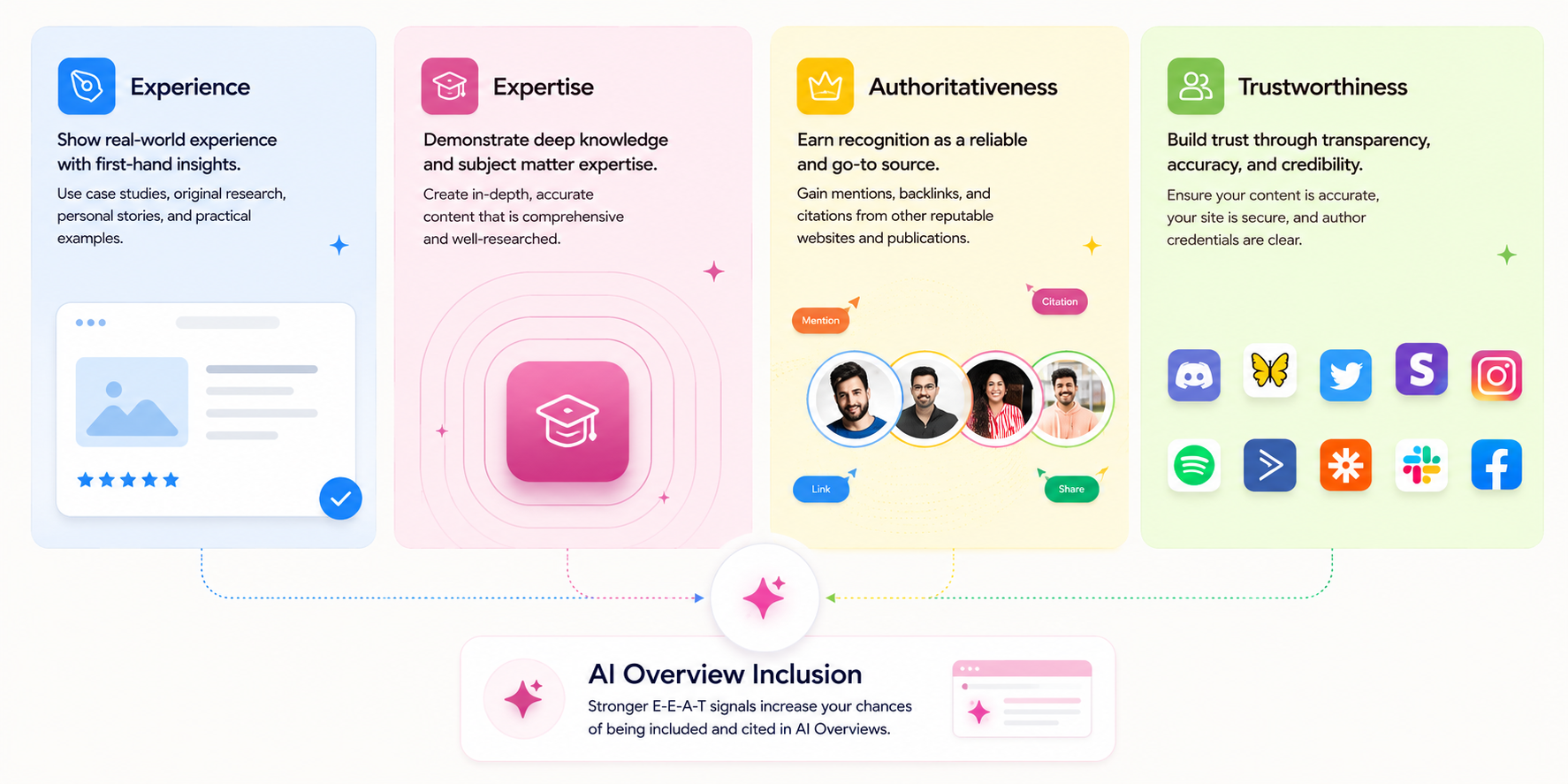
Experience, Expertise, Authoritativeness, and Trustworthiness are evaluated at the page, author, and domain level. AI Overviews amplify E-E-A-T requirements beyond standard organic ranking.
FAQPage, Article, HowTo, and Speakable schema markup help Google identify the most AI-synthesizable content on your pages, improving extraction accuracy and citation probability significantly.
Pages that have earned featured snippets historically show strong correlation with AI Overview citation. The content patterns that win featured snippets — direct question answers, clear structure, authoritative information — are the same patterns AI Overviews favor.
Google matches AI Overview sources to the specific intent of each query segment. Informational content earns informational citations; procedural content earns how-to citations. Match your content format to the dominant intent of each target query.
For topics where recency matters, Google's AI Overviews weight recent content more heavily. Pages with clear publish dates, regular updates, and accurate dateModified schema markup earn freshness preference over static evergreen pages for any topic that evolves over time. Build a content update cadence into your editorial calendar to maintain freshness signals on high-priority pages.
A Google AI Overview has five distinct structural zones: the main synthesis paragraph (150-300 words generated from multiple sources), the source cards (showing domain, title, and excerpt for each cited page), follow-up question chips (query suggestions that extend the search session), an expand/collapse control, and occasionally image or video elements from cited sources. Citation placement within the Overview is determined by which source contributed the most directly to each synthesized claim — pages that supply the clearest, most extractable factual content earn the most prominent source card placement.
On desktop, Google AI Overviews appear as an expanded card at the top of the search results page, above the organic blue links. Source cards are displayed in a horizontal scroll strip below the synthesis text. On mobile, the AI Overview expands to full viewport width, with source cards as tappable thumbnails below the answer. Both formats drive citation awareness and brand discovery even from users who don't click through to your page.
Content that earns AI Overview citations typically has a direct, factual opening sentence, clear H2/H3 subheadings that match query language, and structured data markup that helps Google understand the content type and authority of the page.
Experience, Expertise, Authoritativeness, and Trustworthiness — Google's four-part quality framework — are applied with heightened scrutiny to AI Overview source selection. Because AI Overviews appear in a premium position that Google is explicitly endorsing to billions of users, the quality bar is materially higher than for organic inclusion. A page can rank #1 organically but fail AI Overview inclusion if it lacks demonstrable E-E-A-T signals: named author credentials, original experience, authoritative third-party recognition, and accurate, verifiable information.
Pages without clear author credentials, demonstrable first-hand experience, or third-party authoritative recognition consistently fail Google's E-E-A-T checks for AI Overview inclusion. Google is explicitly endorsing these sources to billions of users and applies its highest quality standards before including any page. Anonymous content, thin expert claims, and pages without backlinks from recognized authoritative sources are systematically excluded.
Pages with thin content — short articles without substantive original information, heavily templated pages, or pages that aggregate information without adding genuine value — are excluded from AI Overview source selection regardless of their organic rank. Google's AI Overview quality layer applies the same Helpful Content signals that penalize thin content in organic rankings, but with stricter enforcement for the premium AI Overview position.
Pages without structured data markup miss the signals that help Google's AI Overview system identify content type, authorship, and key extractable claims. FAQPage, Article, and Speakable schema are particularly powerful for AI Overview inclusion. Without these markup signals, even excellent content may be overlooked in favor of structurally identical content with proper schema implementation that makes extraction easier for Google's AI systems.
Since 65% of AI Overview sources come from top 3 organic results, strong traditional SEO is the most reliable path to AI Overview inclusion. Prioritize content depth, backlink acquisition, and technical SEO on AI-Overview-eligible queries.
Add named authors with full credentials and author pages to every article. Publish original research and case studies that demonstrate real experience. Earn mentions in authoritative industry publications. Build your Knowledge Panel presence.
Add Article schema with Person author markup, datePublished/dateModified, and a clear headline. Add FAQPage schema to Q&A content. Add Speakable schema to identify your most summary-worthy content. Add HowTo schema to procedural content.
Write answer-first paragraphs under descriptive H2/H3 headings. Lead with the direct answer in every section. Ensure every paragraph makes a standalone, independently meaningful point that can be extracted and synthesized by Google's AI system.
Use tools like Semrush or Ahrefs to identify which of your target queries already trigger AI Overviews. Create dedicated content pages specifically designed to answer these high-AI-Overview-rate queries with maximum E-E-A-T and structure.
Track AI Overview appearances using third-party tools. Monitor branded search volume in Google Search Console as a proxy for citation impact. Identify your highest-AI-Overview-rate content and replicate those patterns across your content library.
Our branded search volume went up 40% in the three months after SEO My Clicks got us appearing in Google AI Overviews for our core product queries. We didn't change our paid budget — it was entirely organic citation lift.
Google AI Overviews are AI-generated summary answers that appear at the top of Google Search results pages for eligible queries. Formerly known as Search Generative Experience (SGE) during its testing phase, AI Overviews were fully launched in the US in May 2024 and expanded globally through 2025. They use Google's Gemini language model to synthesize information from multiple web sources into a single, structured answer displayed above traditional organic results. Each AI Overview cites the specific web pages that contributed to the answer, showing source cards that users can click to visit the original content. AI Overviews now appear in approximately 47% of all Google searches.
Google AI Overviews are most commonly triggered by informational queries — questions that seek explanations, definitions, comparisons, or how-to guidance. Queries beginning with 'how,' 'what,' 'why,' 'when,' and 'which' are strong AI Overview triggers. Complex multi-part questions, comparison queries ('X vs Y'), and research-style queries that previously might have generated featured snippets are particularly likely to trigger AI Overviews. Conversely, navigational queries, purely transactional queries, and highly sensitive YMYL queries in health and finance have lower AI Overview rates as Google applies additional quality gates.
Google selects AI Overview sources primarily from its existing organic search index, with a strong correlation to top-ranking organic results. The top 3 organic results for a query supply approximately 65% of AI Overview source content. Google's source selection applies its E-E-A-T signals at the page, author, and domain level. Pages with structured data markup, clear author attribution, explicit factual claims with cited sources, and content written to match the informational intent of the query score highest. Google also draws on its Knowledge Graph to verify facts and identify authoritative sources for specific topics.
Page rank has a strong correlation with AI Overview inclusion. Pages that rank in the top 3 organic positions for a query supply the majority of AI Overview sources. However, rank is necessary but not sufficient — Google also evaluates whether the specific content on each candidate page is suitable for AI Overview synthesis: Is the information clearly structured? Does it directly address the query intent? Does it have strong E-E-A-T signals? A page ranking #1 with vague, poorly structured content may be passed over in favor of a page ranking #5 that has clearer, more extractable information directly addressing the query. Aim for both strong ranking and strong content extractability.
E-E-A-T (Experience, Expertise, Authoritativeness, Trustworthiness) is critically important for AI Overview inclusion — arguably more important than for traditional organic rankings, because AI Overviews surface at the very top of search results and Google applies heightened quality scrutiny to what it endorses in this position. Experience signals include first-person accounts and case studies. Expertise signals include author credentials and industry recognition. Authoritativeness signals include backlinks from recognized industry sources and Knowledge Panel presence. Trustworthiness signals include accurate information with cited sources and transparent authorship.
Publishers can signal their preference not to have their content included in AI Overviews using the nosnippet robots meta tag (which prevents Google from showing any snippet from the page, including in AI Overviews) or the max-snippet tag (which limits snippet length). However, completely opting out of AI Overviews while maintaining organic search visibility is not currently possible through a simple toggle. Google has indicated it is working on more granular AI content usage controls. The calculus for most publishers is that the brand exposure and citation traffic from AI Overview inclusion outweighs the reduction in direct organic clicks, particularly given the 3.2x increase in branded searches that citation drives.
Measuring AI Overview appearances requires multiple approaches since Google Search Console does not yet provide a dedicated AI Overview report. The most direct method is to manually search for your target queries and observe whether your content appears in the AI Overview source citations. For scale monitoring, third-party tools including Semrush, Ahrefs, and Authoritas now offer AI Overview tracking. You can also monitor AI Overview's indirect effects: AI Overview inclusion consistently drives increases in branded search volume, which is measurable in Google Search Console as growth in branded query impressions. Track click-through rates for queries known to trigger AI Overviews, as CTR typically shifts when AI Overviews appear.
Structured data meaningfully helps with AI Overview inclusion. Google's AI Overview system leverages its existing structured data processing infrastructure, meaning pages with relevant schema markup provide cleaner signals about content type, topic focus, authorship, and factual claims. FAQPage schema is particularly effective — questions and answers in FAQPage format are directly compatible with AI Overview's Q&A synthesis format. Article schema with named author Person markup, correct datePublished and dateModified, and a clear headline helps Google evaluate E-E-A-T. HowTo schema for procedural content and Speakable schema to identify the most summary-worthy content sections also correlate with stronger AI Overview presence.
SEO My Clicks builds the E-E-A-T signals, structured data, and content optimization strategies that put your brand in Google AI Overviews — the most valuable real estate in modern search. Start with a full AI Overview audit.
What our clients say