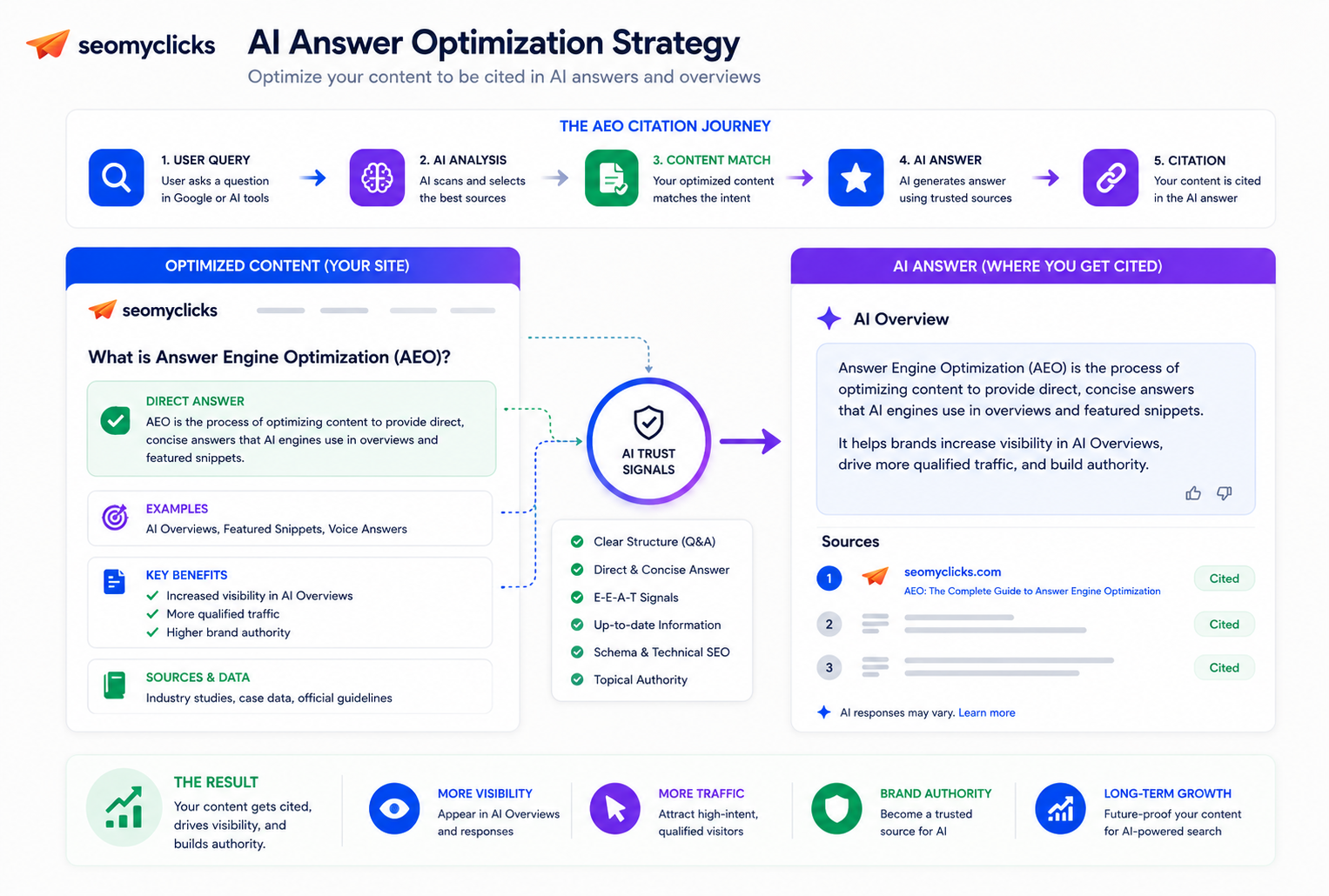
Only 18% of businesses have optimized for AI citation. The window to build first-mover authority across ChatGPT, Perplexity, Google AI Overviews, and Gemini is open right now.
Appearing in AI-generated answers is not accidental. It requires deliberate optimization across four interconnected disciplines that AI engines use to select and verify sources before surfacing them to users.
Content extractability is the single most actionable lever in AI citation optimization. It refers to how cleanly and accurately an AI engine can pull a specific answer from your page. When a user asks ChatGPT or Perplexity a question in your category, the AI scans web content looking for a passage that directly and unambiguously answers the query. If your content is buried inside dense prose paragraphs without structural cues, it gets skipped — or worse, partially extracted in a way that misrepresents your position.
High extractability content follows a clear formula: open every major section with a direct, one-to-two sentence answer to the implied question. Use H2 and H3 headings written as questions that mirror real user queries — not clever marketing headlines. Include FAQ sections on every key page, with both the question and answer fully spelled out. Present key facts as standalone sentences or list items rather than burying them mid-paragraph.
AI engines do not cite random websites — they cite entities they have verified as legitimate, credible actors in a given category. Entity authority is how AI systems determine whether your brand deserves to be recognized as a trusted source. This verification happens through a network of signals that mirror how Google's Knowledge Graph works, but extends across the broader web graph that large language models were trained on.
Building entity authority starts with ensuring your brand's core identity data is consistent across every platform where you have a presence. Your business name, address, phone number, and category description should be identical on your website, Google Business Profile, LinkedIn company page, Crunchbase, G2, and any industry directories. Inconsistencies signal to AI systems that the entity is fragmented or unverified. Beyond NAP consistency, earning inclusion in authoritative reference sources — industry publications, Wikipedia citations, analyst reports — substantially elevates how AI engines weight your content as a citation source.
AI engines do not rely solely on your own content to decide whether to cite you. They cross-reference multiple independent sources to verify that external authorities also recognize your brand as credible in your category. This is the AI equivalent of off-page SEO, and it is arguably the most powerful signal for establishing citation trustworthiness — particularly for newer brands or in competitive categories where many sources are competing to be cited.
Third-party corroboration means earning genuine external mentions from authoritative sources. This includes PR placements in industry publications, guest content on high-authority blogs, inclusion in expert roundups and listicles, podcast appearances where your expertise is documented, and analyst or research citations. The strategy is not simply about volume — a single mention in a high-authority publication can outweigh dozens of lower-quality references. Target publications and platforms that AI engines demonstrably draw from in your category by auditing which sources are cited when you run test queries.
Freshness is among the most underestimated and most actionable signals in AI citation optimization. Research consistently shows that approximately 50% of content cited by AI engines was published or significantly updated within the past 13 weeks. This is what we call the 13-Week Rule: any content that has not been meaningfully refreshed within a rolling 13-week window faces systematic deprioritization by AI citation algorithms relative to fresher competitors covering the same topic.
The freshness signal is communicated to AI engines through multiple channels. The dateModified field in your Article schema must be updated to reflect the actual date of each content refresh — not just the original publication date. A visible "Last Updated" date on the page itself provides an additional human-readable freshness signal. The content itself must contain genuinely updated information: new statistics, updated data points, references to recent developments in the field. Superficially updating a date without adding new substance is detectable and ineffective.
The complete AI citation optimization framework, distilled into actionable modules.
A complete AI citation strategy requires all four pillars working in parallel. Missing any one creates a critical gap that limits citation frequency across all engines.
Structure content so AI engines can pull clean, accurate answers without misrepresenting your message.
Businesses that achieve consistent AI citation see an average 340% increase in branded search volume over a 6-month period as AI-driven discovery compounds into direct intent searches.
AI engines cross-reference multiple independent sources. Build external authority through:
50% of AI-cited content is under 13 weeks old. Content older than this without a genuine refresh is systematically deprioritized. Update dateModified schema and add new data each cycle.
A 0–100 scoring framework that measures your citation rate across all major AI engines relative to your tracked query set.
How it's calculated:
Most clients start at a score of 0–8. Top performers reach 40–65 within 6 months of optimization.
Implement these schemas in priority order for maximum AI citation signal:
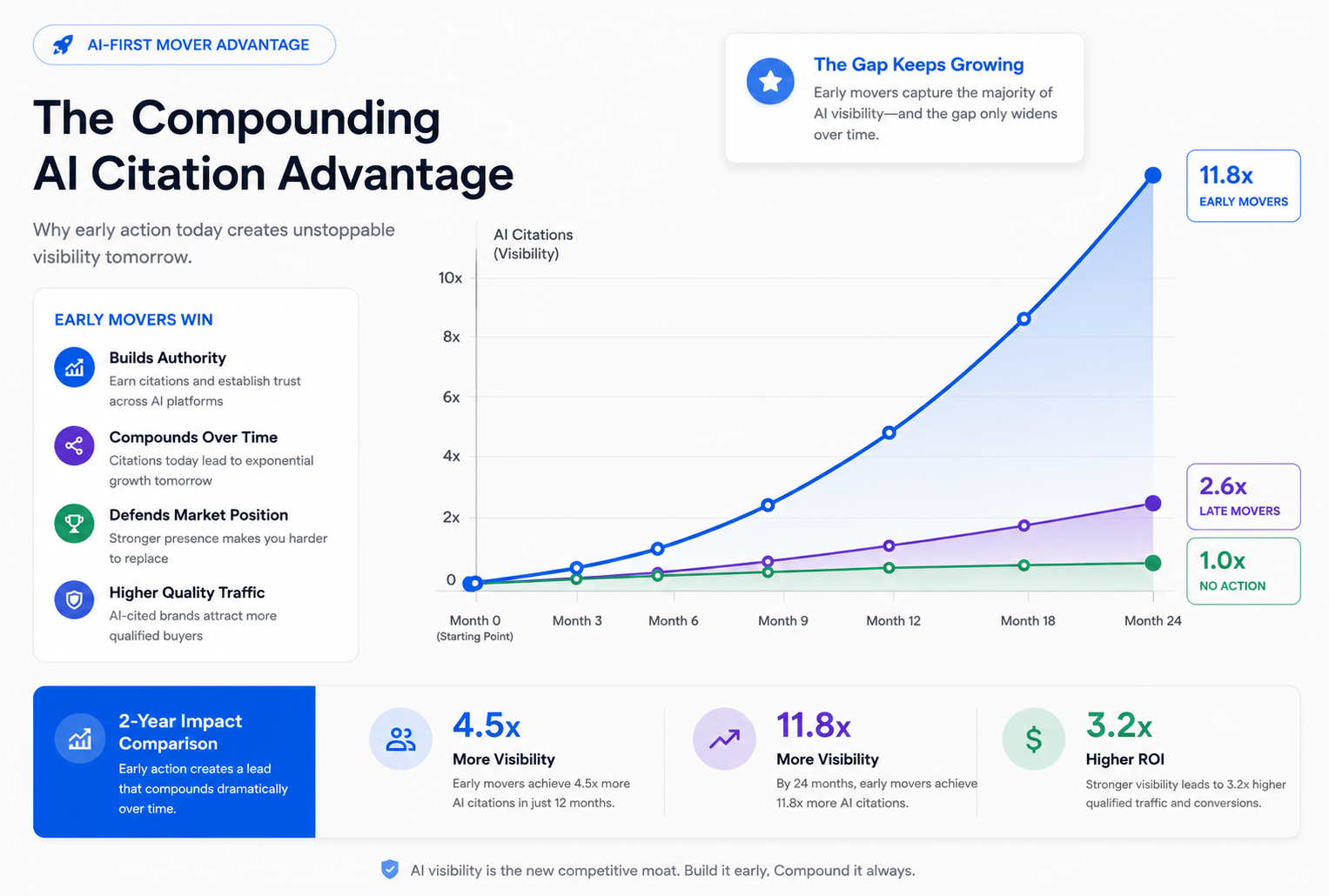
AI citation authority is not linear — it compounds. The first citations your brand earns increase your entity authority signals, which makes it easier for AI engines to verify you as a credible source, which increases the likelihood of future citations across more query types and more AI engines.
Businesses that begin AI citation optimization now are building a moat that grows more defensible every month. Each citation generates brand awareness that drives branded searches, which feeds back into organic signals, which strengthens your overall authority profile. By month six, early optimizers are typically appearing in 3-4x more AI answers than competitors who started alongside them but waited.
The window for first-mover advantage in AI citation is measurable and finite. As more competitors adopt structured content and entity verification practices, the marginal gain from being early diminishes. The compounding clock started the moment AI search became mainstream.
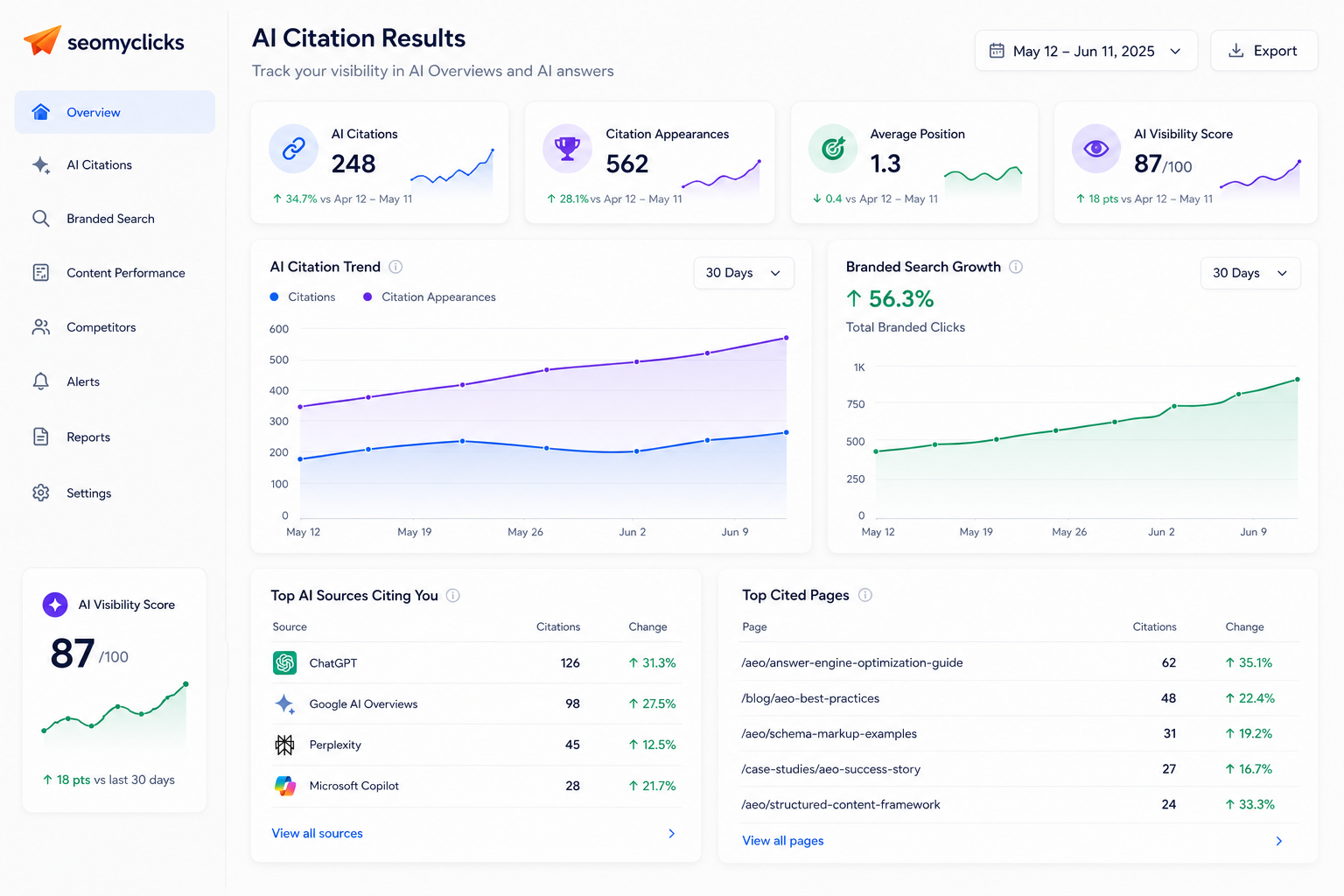
What it looks like when your content is cited as an authoritative source across desktop and mobile AI interfaces.
Early movers in Generative Engine Optimization consistently see 3-4x more AI mentions than competitors who begin optimizing six months later, even when the late entrants produce equivalent content quality. The reason is compounding entity authority: AI engines build probabilistic models of which sources are reliable in each topic area, and early citations reinforce those models in ways that later citations cannot fully overcome.
The data is unambiguous: in category after category, the brands that established AI citation presence in the first half of 2025 now dominate the answer surfaces for their highest-value queries. Brands beginning optimization today face a harder but still very achievable path — the window is narrowing, not closed.
Every week of delay is a week of compounding authority your competitors are building. The businesses appearing in AI answers for your highest-intent queries are capturing demand at the very top of the funnel, before users even visit a website. That invisible traffic gap is growing.
Start Building Your AI Authority →
Three systematic gaps that keep business content invisible to AI engines — no matter how good the underlying expertise is.
Publishing content that is written as flowing editorial prose — without question-format headings, direct-answer openings, or FAQ sections — makes it nearly impossible for AI engines to extract clean, accurate responses. The AI either skips the page entirely or pulls a fragment that may not represent your best answer. Expertise alone does not generate citations. Structure is what makes expertise extractable.
AI engines verify brand credibility by cross-referencing your identity across multiple authoritative platforms before deciding to cite you. If your brand lacks a complete Google Business Profile, is absent from LinkedIn, G2, and Crunchbase, or has inconsistent NAP data across platforms, AI systems cannot reliably verify your entity — and unverified entities do not get cited. Content quality cannot compensate for entity verification gaps.
Approximately 50% of all AI-cited content was published or genuinely updated within the past 13 weeks. Content that has not been refreshed beyond this threshold is systematically deprioritized, regardless of its original quality or the authority of its source domain. Many businesses produce excellent cornerstone content and then leave it untouched for years — making it increasingly invisible to AI citation selection as time passes without updates.
A structured implementation sequence that takes businesses from zero AI citations to consistent multi-engine presence within 6-10 weeks.
Run 20 or more category queries across ChatGPT, Perplexity, Google AI Overviews, and Gemini. Record citation rate and identify which competitors are currently being cited. Establish your baseline AI Visibility Score (0-100).
Rewrite key pages to open with direct answer statements. Convert all H2/H3 headings to question format matching real user queries. Add FAQ sections with schema markup to every key conversion page and pillar content piece.
Verify and complete profiles on Google Business Profile, LinkedIn, G2, and Crunchbase. Implement Organization schema with sameAs links. Ensure NAP consistency is exact across all platforms. Target Wikipedia citation opportunities.
Execute a targeted PR campaign placing content in publications AI engines draw from in your category. Contribute expert guest content, appear in roundups, and earn podcast citations. Audit competitor citation sources and target the same outlets.
Deploy FAQPage, Article, HowTo, Speakable, and Organization schemas across all key pages. Validate using Google's Rich Results Test. Ensure dateModified is set correctly and updated with each content refresh cycle.
Establish a quarterly content refresh calendar. Update all key pages with new data and developments every 13 weeks. Reset dateModified in schema. Re-run AI visibility audit after each refresh wave to track citation rate improvement.
After restructuring our top 20 pages with SEO My Clicks' approach, 14 of them were appearing in ChatGPT answers within 7 weeks. Our branded search more than tripled.
Everything you need to know about AI citation optimization, answered with the same directness we recommend for your own content.
SEO My Clicks implements the complete AI citation optimization stack across ChatGPT, Perplexity, Google AI Overviews, and Gemini. Most clients see their first AI citations within 6–10 weeks. Get your free AI visibility audit today.
What our clients say